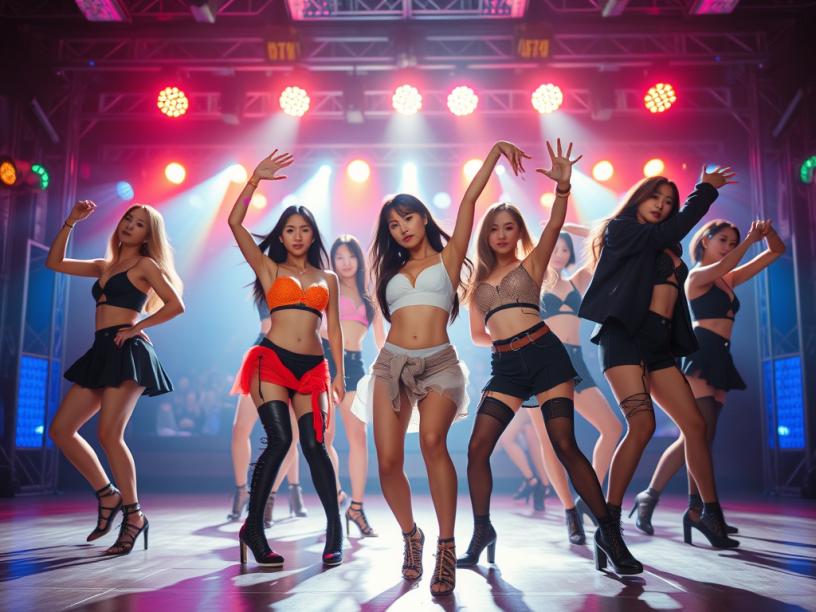
Before someone accuses this modest wordsmith of plagiarizing the title of this week’s column, would like to credit the title to the brilliant poet, Arthur O’Shaughnessy.
Last week, to launch my new website, I wrote a brief editorial called, “THE ART OF SEX: An Argument Against KPOP“. This was an attempt to argue the difference between art and (garish) entertainment, and how Korean popular music, “hallyu” falls into the latter and most certainly not the former.
The ‘Seoul sound’ that embodied the disgruntled youth of the nineties began to wither in the early part of the last decade. It was crushed under the weight of the addictive and artistically unsophisticated opiate for the Korean commonage. (A passage from THE RISE OF PUNK)
Popular Music as Entertainment
Apparently, this opinion piece of mine has garnered some notice by supporters and fans of the tawdry class of entertainers here in Korea. These ardent debauchee-defenders of the singing, semi-clad clones failed to notice that I ended my editorial with, “If KPOP works for you as a form of savage escapism, than I will concede that it does have value…” I made an effort in my last article to ensure that I have no problem with people enjoying the ‘seductive seasonal sounds’ of these half-naked dancers on stage lip-syncing to an audience of twelve year olds. Only later I would find out that apparently the audience isn’t only embryonic ‘valley girls,’ but to reasons initially beyond my comprehension, 30- and 40-something year old men. Oh wait … Now I get it. I just now put it together why forty-year old dudes sitting in front of their computer streaming KPOP concerts from YouTube so “lustfully” defend this alternative form of musical lingerie charades. In between their nightly sessions – where these sweaty old weirdos have one hand firmly on their computer mouse, and the other suspiciously lost below their desk – they have engaged in a Twitter and Email campaign to let me know just how pathetic I and my writing is.
The goal of this article was simply an attempt to lay out the reasons why KPOP is not a form of art.
“Play it Fuckin’ Loud!”
That is a quote from one of the greatest artists of all time, Bob Dylan. Music is all about uncompromising “enterprise and artistry.” Music requires passion, risk, innovation, and emotion. Music has gone beyond the early days of just pitch, rhythm, and melody. It is an expressive art form that (should) engage the audience. Entertainment on the other hand, is anything that may amuse us for a moment’s time. The most common definition of “entertainment” that I could find was roughly described this way; “Entertainment is something that holds the attention of an audience, or gives pleasure and delight.”
Some have accused me of being an elitist, a title often ascribed to me, and one that I am willing to acquiesce to – if that is the moniker that comes with being a ‘defender of music’. “Music is … a higher revelation than all Wisdom and Philosophy“, a quote that I could hardly disagree with, a quote from a true artist, gifted in ways this humble elitist could hardly comprehend, Ludwig van Beethoven. Where does KPOP fit into LVB’s definition?
KPOP: The Art of Selling Cellphones and Fried Chicken
I am of course willing to concede that there an obvious, if not distasteful, entertainment value that comes with Korean popular music. I have never presumed otherwise. While I in no way find the suggestive dancing and over-engineered auto-tuned songs of many of the performers in Korea entertaining, that isn’t to take away from the many in this country and around the world, that clearly are addicted to this form of entertainment. The purpose of, and the only reason KPOP exists, is to serve as a commercial enterprise. For that I commend it. I can already predict the email responses to this comment. And while yes, many other music genres, pander to corporate interests and license their music out to T.V. commercials, Korea perfected the idol-caste system to do only that.
The vast majority of the ‘questionably sophisticated’ audience in Korea appear to love it and essentially do whatever their idols tell them to do. If LG, BHC, and others can profit off of the use of these trumpeted singing lingerie models, than I say as a commercial enterprise, “why not?“.
Regardless of the ubiquity of popular ‘music’ these days, it doesn’t legitimize or even establish it as an art requiring skill or vision. And despite my dislike, it is still entertainment for many. In the West, capable artists are more able to establish themselves as individuals with a unique sound or vision, whereas in Korea, bands and labels only seem to want to clone past successes. True ‘music by numbers’.
Twitter followers and record sales are essentially guaranteed when you have an entire industry toiling away behind the scenes ensuring your success for a at least a record or two. The popularity of the these groups isn’t anything more than a stellar case of social and commercial engineering.
If you want to turn your brain off at the end of everyday and watch the robotic pole dancing of tweens as a means to unwind, being that this it is indeed a free country, I encourage you to do that. I personally prefer my art to engage and challenge me. I both enjoy and require my music to contribute something to my being.
If music be the food of love, play on,
Give me excess of it; that surfeiting,
The appetite may sicken, and so die.
W. Shakespeare
Originally Published: SEOULfi, June 2013
 Sabrina Constance