
The Privilege
As a woman that has been in Korea for over ten years; living in just about every type of community this country has to offer; from the smallest townships to the thronged jewel in the nation’s capital, Gangnam, I can say with some measure of authority, I have lived in and experienced the many facets of Korean culture. Many of us who have been in Korea for any significant amount of time share these familiar experiences, and though we may move from city to city on occasion, Busan to Bucheon, we build circles of friends, engineer lives, and at times even start families here. We pay taxes, contribute to the local economy, and over time, this bizarre, tempting country becomes our home.
Nearly a decade has passed to the day after graduating from university, a chapter of my life so distant now it seems to be more mythos than material. Korea has, in her seductive ways inveigled me, and unquestionably to the dismay of my family back in my native Canada. I have in some small, but absolute measure, made a life here.
This past August, the city of Seoul assessed me a small remittance, a levy, one that I liken as to ‘the privilege of living in the city.’ As a matter of principle, I informed the Gangnam District Office that I won’t be paying their “air tax.” I couldn’t in good conscience invest in a community that has shown a disinterest in investing in their residents. In a meeting and many subsequent emails and phone calls, I informed them that I felt uncomfortable paying what they have so named, their “equality tax”. In no uncertain terms, I told them that until they make ‘meaningful efforts to include long-term residents, such as myself and the many reading this, into the decision process of how such money is to be spent,’ I won’t be paying this, or any other property tax.
A Continuum of Consciousness
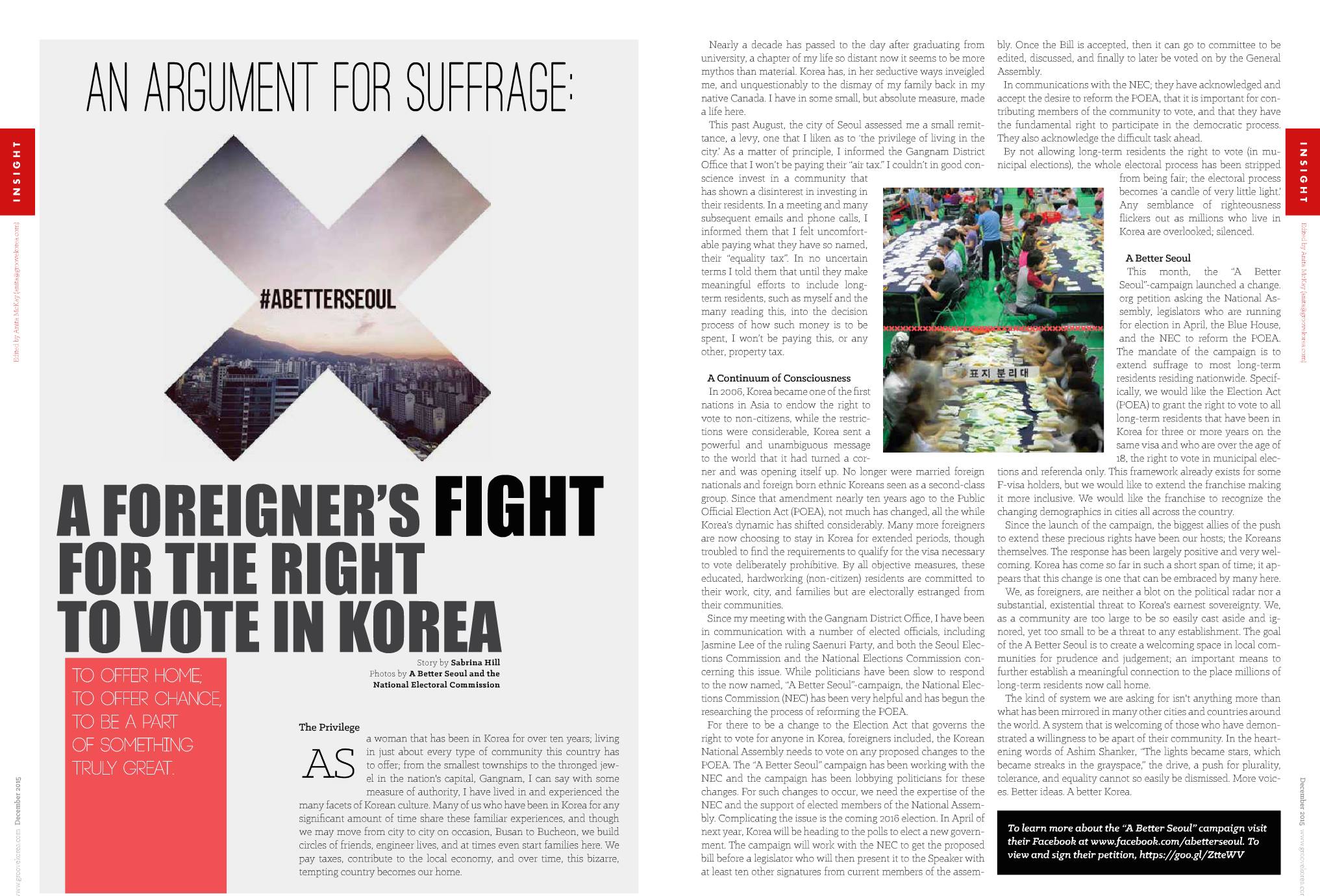
In 2006, Korea became one of the first nations in Asia to endow the right to vote to non-citizens, while the restrictions were considerable, Korea sent a powerful and unambiguous message to the world that it had turned a corner and was opening itself up. No longer were married foreign nationals and foreign born ethnic Koreans seen as a second-class group. Since that amendment nearly ten years ago to the Public Official Election Act (POEA), not much has changed, all the while Korea’s dynamic has shifted considerably. Many more foreigners are now choosing to stay in Korea for extended periods, though troubled to find the requirements to qualify for the visa necessary to vote deliberately prohibitive. By all objective measures, these educated, hardworking (non-citizen) residents are committed to their work, city, and families but are electorally estranged from their communities.
Since my meeting with the Gangnam District Office, I have been in communication with a number of elected officials, including Jasmine Lee of the ruling Saenuri Party, and both the Seoul Elections Commission and the National Elections Commission concerning this issue. While politicians have been slow to respond to the now named, “A Better Seoul”-campaign, the National Elections Commission (NEC) has been very helpful and has begun the researching the process of reforming the POEA.
For there to be a change to the Election Act that governs the right to vote for anyone in Korea, foreigners included, the Korean National Assembly needs to vote on any proposed changes to the POEA. The “A Better Seoul” campaign has been working with the NEC and the campaign has been lobbying politicians for these changes. For such changes to occur, we need the expertise of the NEC and the support of elected members of the National Assembly. Complicating the issue is the coming 2016 election. In April of next year, Korea will be heading to the polls to elect a new government. The campaign will work with the NEC to get the proposed bill before a legislator who will then present it to the Speaker with at least ten other signatures from current members of the assembly. Once the Bill is accepted, then it can go to committee to be edited, discussed, and finally to later be voted on by the General Assembly.
In communications with the NEC; they have acknowledged and accept the desire to reform the POEA, that it is important for contributing members of the community to vote, and that they have the fundamental right to participate in the democratic process. They also acknowledge the difficult task ahead.
By not allowing long-term residents the right to vote (in municipal elections), the whole electoral process has been stripped from being fair; the electoral process becomes ‘a candle of very little light.’ Any semblance of righteousness flickers out as millions who live in Korea are overlooked; silenced.

EXPLORING THE NIGHT IN PAJU: A Tale of Two Koreas
Just five-hundred meters across this veiled river, existing in the persistent blackness of the rogue nation to the North, a town with no name settles into night. An eerie silence lingers – like the low notes of a classical piano sonata. And as the sun sets over the village, she blithely cloaks herself; her collective…


WADING THROUGH SHALLOW WATERS: From North Korea to Freedom in the South
A child walks along a barren countryside road in North Korea — not more than a few dozen kilometres from the Demilitarized Zone. A forest on her left has long been pillaged for fuel and an empty rice field on the right is bone dry from years of economic and agricultural mismanagement. She stumbles across…
A Better Seoul
This month, the “A Better Seoul”-campaign launched a change.org petition asking the National Assembly, legislators who are running for election in April, the Blue House, and the NEC to reform the POEA. The mandate of the campaign is to extend suffrage to most long-term residents residing nationwide. Specifically, we would like the Election Act (POEA) to grant the right to vote to all long-term residents that have been in Korea for three or more years on the same visa and who are over the age of 18, the right to vote in municipal elections and referenda only. This framework already exists for some F-visa holders, but we would like to extend the franchise making it more inclusive. We would like the franchise to recognize the changing demographics in cities all across the country.
Since the launch of the campaign, the biggest allies of the push to extend these precious rights have been our hosts; the Koreans themselves. The response has been largely positive and very welcoming. Korea has come so far in such a short span of time; it appears that this change is one that can be embraced by many here.
We, as foreigners, are neither a blot on the political radar nor a substantial, existential threat to Korea’s earnest sovereignty. We, as a community are too large to be so easily cast aside and ignored, yet too small to be a threat to any establishment. The goal of the A Better Seoul is to create a welcoming space in local communities for prudence and judgement; an important means to further establish a meaningful connection to the place millions of long-term residents now call home.
The kind of system we are asking for isn’t anything more than what has been mirrored in many other cities and countries around the world. A system that is welcoming of those who have demonstrated a willingness to be apart of their community. In the heartening words of Ashim Shanker, “The lights became stars, which became streaks in the gray-space,” the drive, a push for plurality, tolerance, and equality cannot so easily be dismissed. More voices. Better ideas. A better Korea.
Originally Published: Groove Korea, December 2015
 Sabrina Constance