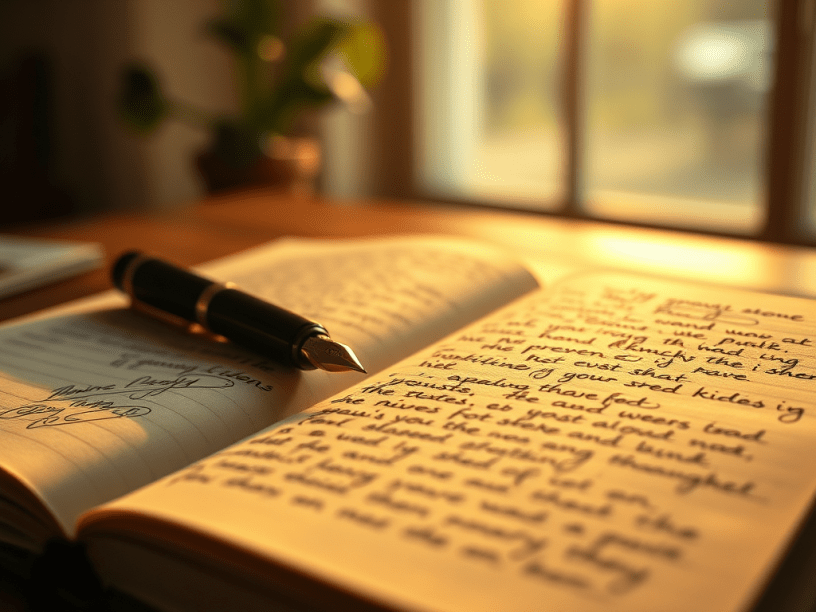
When I return to the journals I kept through August and into September, I’m struck by how restless I was—how hungrily I scanned my body for proof that something was shifting. So many entries were threaded with impatience, frustration, and a quiet fear that I might be the one exception, the one for whom hormones would refuse to take root. I wrote like someone waiting for a tide to turn, counting ripples as if they were waves.
What you’ll read next are the private notes I wrote to serve as my witness—imperfect but earnest—to the earliest stages of my transition. They were my way of anchoring myself in a process that made time feel elastic, sometimes unbearably slow, sometimes startlingly quick. In these pages, I was learning how to navigate the unfamiliar: a body in flux, institutions that turned me away, and the uncomfortable truth that I could not move through this journey entirely on my own. I was discovering, reluctantly, that autonomy is not the same as isolation, and that needing help didn’t diminish the legitimacy of my becoming.
I didn’t know, writing then, where I would end up by 2020, or whether I would feel satisfied with my progress. I only knew that I had stepped off a ledge without a map, trusting that something in me would rise to meet the fall. What I see now is that transition is not something one completes. It is an unfolding—not a single shift in shape, but a long conversation between fear and hope, between what the world denies and what we insist on becoming anyway.
- The entry starting August 13th is pieced together from several entries over the rest of the month and late September.
Friday, August 13th, 2010 (Day 15, Week 3)
I missed my scheduled HRT injection day—my second shot. I left work early and hurried to a nearby hospital, hoping to salvage the day. Instead, I was told with a practiced indifference that “no doctor was on duty.” No nurse, they insisted, could help me. No syringe could be provided. The refusal felt too rehearsed, too convenient, the kind of lie an institution tells when it wants to avoid saying what it actually means.
I am not someone who easily asks for help. I know this stubbornness is one of the more unsatisfying traits I carry—this insistence on self-reliance, this reflexive belief that I should be able to handle everything on my own. Yet transition has been the one process that has exposed just how much of that is an illusion. I keep finding myself relying on others—friends, nurses, doctors, strangers with latex gloves and clipboards. Every time an institution tells me it can’t help, or won’t help, it presses on a bruise I don’t like to acknowledge: the fear that I am helpless, or worse, useless. And in Korea, that denial becomes intertwined with something sharper—barriers in the healthcare system that people with specialized needs, people like me, are simply not expected to have. Or to survive.
Days later, I woke early and took a bus into Gangnam for my rescheduled injection. My doctor saw me without an appointment—an unexpected grace. I showed him the bruise from the first shot. He explained it was nothing serious, just a vessel the needle might have nicked. But my body felt like unfamiliar territory, a map I was still learning to read.
When the nurse demonstrated how to self-inject, her hands moved with an economy that made the act look simple. Mine trembled just imagining it. The fear of doing it wrong—of hitting the wrong angle, the wrong vessel—felt like a metaphor I wasn’t prepared to unpack. I asked a friend, a registered nurse, if she could help next time. She agreed, though something in her hesitation made me wonder if she was as nervous as I was.
At first, the changes were nearly imperceptible. A softness in my skin. A subtle shift in the way my arms and legs looked in the mirror. Friends pointed it out before I dared believe it.
And these early changes—years later I recognize them as slight—felt monumental in the moment. They were proof that everything leading up to this—the appointments, the bureaucracy, the needles, the anxiety—was beginning to pay dividends. In earlier entries in this journal, I wrote about how part of my motivation was witnessing the joy of friends and trans creators who had gone before me. Their transformations had looked effortless from afar, their happiness so luminous it seemed inevitable. Now it was my turn. I had only walked a few meters along what I knew would be a lifelong journey, the path ahead still fogged with mystery, but there was already distance between who I had been and who I was becoming.
I’ve always been the type to leap before fully mapping what lies ahead or below—if we continue with this metaphor. I had read about HRT for years, thought about transition for longer, but the truth was I didn’t know exactly what this would look like on my body. There was mystery in that uncertainty. I had stepped off the ledge of relative safety, with no promise of calm water beneath me, but I was ready to face whatever the sea offered.
There was another fear too, one I hadn’t admitted aloud. I think many trans people worry their hormones won’t “work,” not the way they seem to for others. That they will be the exception, the one whose reflection refuses to move. But when the changes finally began—tiny, shy, almost whispered—I felt that fear loosen its grip.
Two weeks later, my breasts began to swell. Just slightly, but enough to tell me something real was happening. A growing core, a quiet ache, especially those first few days after each injection. I noticed it most in the mornings, especially in the shower, where sensations sharpened and the water traced every shift in my skin.
A month in, people started telling me I looked more feminine. I wasn’t expecting that—not yet. Not so soon. I thought the face was the last thing that would change. I thought years would pass before anyone noticed. But there it was: the reflection softening, the stranger in the mirror finally stepping closer.
And beneath all of it—the bus rides and needles and bruises, the bureaucratic refusals, the small mercies—sat the question I hadn’t yet articulated:
What does autonomy look like when institutions deny it to you?
Maybe it looks like this:
a woman learning to build herself anyway.
A woman leaping without seeing the water.
A woman accepting help not as failure but as part of survival.
A woman who keeps moving forward—even when the world tells her she shouldn’t, or can’t, or must wait for someone else’s permission.
Maybe autonomy isn’t doing it alone.
Maybe autonomy is choosing your direction—even when you need others to help carry you toward it.
This was originally written on Friday, August 13th, 2010, with a prologue added November 5th, 2020, and then edited again December 12th, 2025.
Make a one-time donation
Make a monthly donation
Make a yearly donation
Choose an amount
Or enter a custom amount
Your contribution is appreciated.
Your contribution is appreciated.
Your contribution is appreciated.
DonateDonate monthlyDonate yearly
On Not Disappearing
I am not good at making lifelong friends. My record is uneven, marked by distance and missed chances. Going stealth would have only deepened that pattern. More importantly, it would have meant abandoning the mercy, empathy, and action shown by the people who stood beside me. I needed their proximity—not just their support, but their…

PART 3 – NO PERMISSION NEEDED: What Was Once Shame Has Become Pride
What began as innocent play, the joy of dressing up and pretending, soon curdled into confusion and punishment. My parents’ gentle corrections hardened into anger, their voices faltering with something more akin to unrelenting impatience. My pleas — small, wordless, desperate — were dismissed as misbehaviour. How could I have explained, at four or five…
PART 2 – SHAPE OF BECOMING: Grief, Legacy, and Inheriting Her Echo
Grief is a complex journey, shaping identity through loss and memory. Sabrina reflects on her relationship with her mother, navigating absence, longing, and legacy. While struggling to inherit her traits, they ultimately find strength and validation in her mother’s enduring voice, guiding them towards self-acceptance and growth.
 Sabrina Constance