
WHAT IS THE NOTWITHSTANDING CLAUSE?
In the context of Canadian constitutional law, the “notwithstanding clause” refers to section 33 of the Canadian Charter of Rights and Freedoms, which is part of the Constitution Act, 1982. This provision allows federal or provincial governments to pass laws that temporarily override certain rights and freedoms guaranteed by the charter.
The notwithstanding clause allows legislatures to explicitly “Opt out” of the application of certain sections of the charter, particularly the fundamental freedoms (section 2), legal rights (sections 7–14), and equality rights (section 15). In essence, it grants the government the ability to pass laws that violate certain charter rights for up to five years.
Many legal scholars and critics argue that the notwithstanding clause undermines the fundamental principles of constitutional protection for rights. Some worry that it allows governments to trample on rights without proper judicial oversight.
To be clear, the use of the notwithstanding clause is a nuclear option and the government’s way of sidestepping fundamental rights.
THE THREAT HERE AT HOME
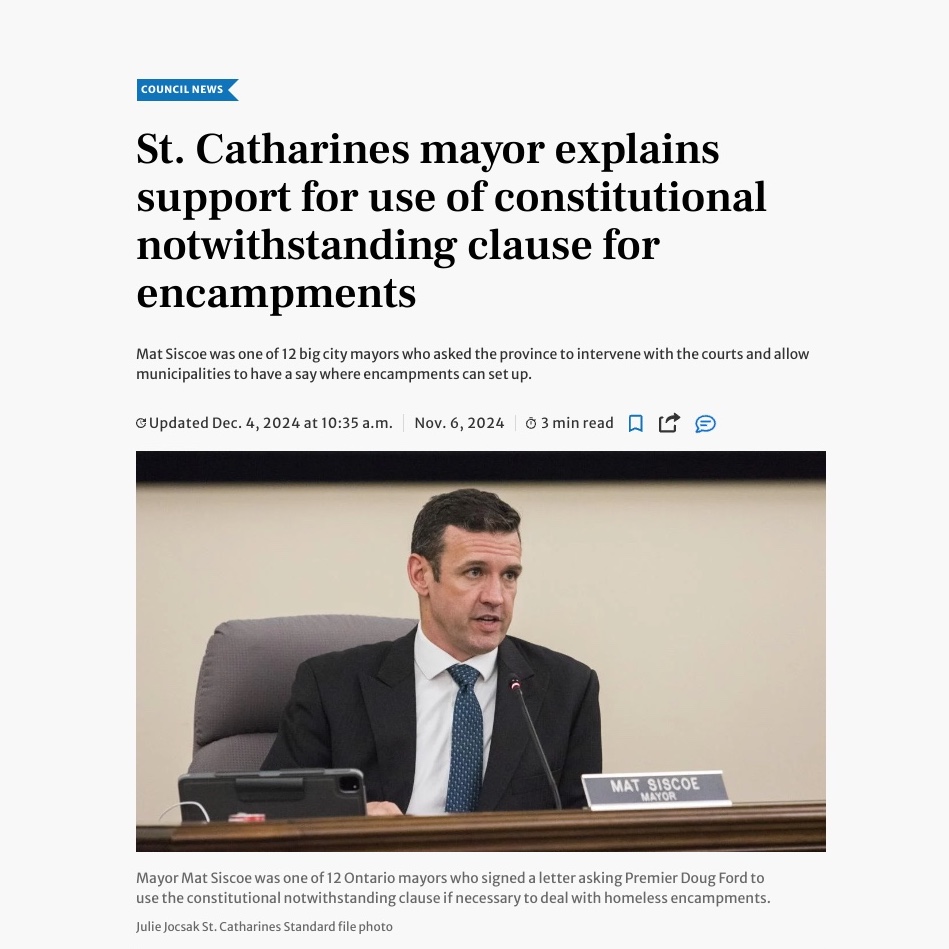
Recently, news stories have reported that the mayor of St. Catharines supported the suspension of the charter. Let’s discuss Mat Siscoe’s contradictory statements.
St. Catharines mayor Mat Siscoe has been on record as saying ‘the city shouldn’t tear down encampments if there is nowhere for unhoused people to go.‘ The mayor has also been very public in recent days about his support of suspending the rights of unhoused individuals.
Mat claims that he ‘wants the ability to move encampments out of sensitive areas‘ like near schools or up against residential homes. However, where in the city is both “out of sensitive areas” but also provides access to the daily services many of these marginalized and vulnerable individuals need?
Mat doesn’t have an answer for that.
I plan on putting together a longer episode for my UNHOUSED series that will discuss the hypocrisy of Mat Siscoe, the City of St. Catharines, and the many well-documented failures of our municipal governments here in Niagara to come up with solutions to our growing poverty and homelessness, and addiction issues.
Regrettably, the city’s leadership lacks competence or is driven by motives that raise serious ethical concerns. They seem to possess only a superficial grasp of the underlying issues related to poverty, and they appear unaware of the implications of the notwithstanding clause and its potential misuse for ulterior purposes.

On The Myth of Canadian Exceptionalism
This is not an argument that Canada is Mississippi in 1964—but no society arrives at that point by accident. The same dynamics are visible here at home. They surface in the normalization of hateful rhetoric online and in public spaces across Canada, including here in Niagara. Those advancing this rhetoric often insist they are merely…


On My Fight with the NRPS
Until now, I have carried this case largely on my own. I authored the original complaint. I survived the first major procedural hurdle. I researched and drafted a comprehensive response to the NRPS “defence”—a document prepared by a team of taxpayer-funded lawyers with decades of combined experience. I met the system where it stood, with…

On Not Disappearing
I am not good at making lifelong friends. My record is uneven, marked by distance and missed chances. Going stealth would have only deepened that pattern. More importantly, it would have meant abandoning the mercy, empathy, and action shown by the people who stood beside me. I needed their proximity—not just their support, but their…
 Sabrina Constance