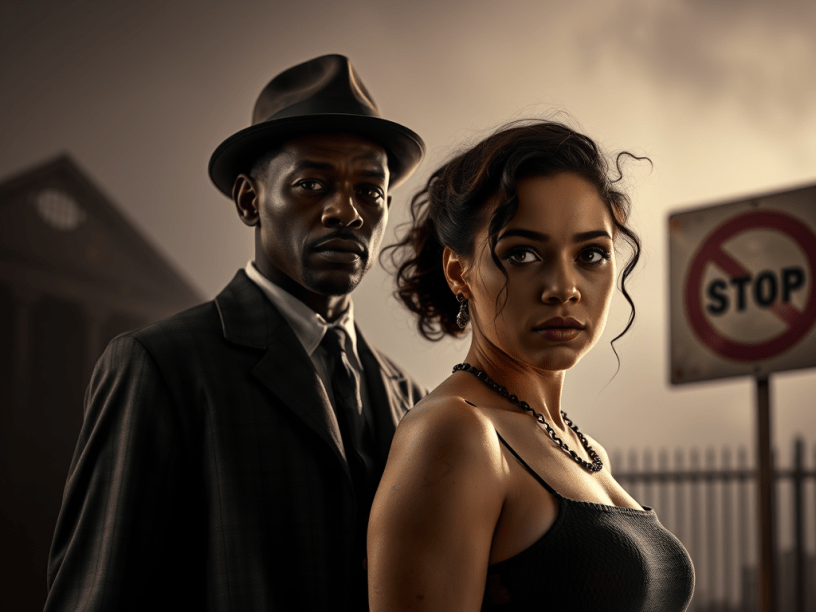
The faces change, but the tactic stays the same: yesterday, it was the black man supposedly threatening white womanhood; today, it is the trans woman supposedly “endangering public safety.” In both cases, the call to “protect women and children” has less to do with safety and everything to do with control.
Throughout American history, the phrase “Protecting Women and Children” has served as a powerful rhetorical tool to justify exclusion, violence, and the denial of civil rights. During the Jim Crow era, white supremacists frequently invoked the supposed threat that Black men posed to white women to defend racial segregation, lynching, and the broader system of white supremacy.
Today, similar language is being used against transgender individuals—particularly trans women—under the guise of “defending the safety and dignity of cisgender women and children.” From bathroom bills to sports bans and book censorship, the recent rise of transphobic policies relies on the same fear-driven narrative that was used to justify past injustices.
These tactics reveal a consistent pattern: moral panic, based on imagined threats, is weaponized to maintain the status quo and marginalize those who are already pushed to society’s edges.
The invocation of “protecting women and children” in both Jim Crow era segregation and modern anti-trans rhetoric demonstrates how moral panic is recycled to legitimize discrimination, revealing not genuine concern for safety but a sustained effort to reinforce dominant racial, gender, and social hierarchies.
Over the years, paternalistic and white supremacist ideologies have evolved and transformed, although they have never truly vanished. The Overton window has shifted; it is no longer socially or legally acceptable to use these false narratives to justify violence against people of colour (though with Trump, apparently bigotry is not only both sanctioned, but also an easy means to grift). While racism and xenophobia persist among the remaining individuals of this generation and their descendants, the paternalistic drive to marginalize communities has taken on a new form. Those who once advocated violence against the “scary black man” have now adopted a new cause: protecting their vulnerable, defenceless women from a new perceived threat. And let’s be clear, there are considerable overlaps on the Venn diagram between the racists and the transphobes. These so-called “real men”—primarily cisgender, white, Christian men—believe they need to safeguard their weak, chaste women from “the scary trans woman.“
JUSTIFICATION OF SEGREGATION LAWS (JIM CROW ERA)
The justification for segregation in public facilities, especially in transportation and restrooms, was often rooted in the unfounded belief that it served to ‘protect white women from black men.’ Southern lawmakers and white supremacist organizations propagated the notion that racial integration would lead to the “mixing of the races,” implying that mere proximity to black men posed an inherent moral and physical danger to white women. A striking illustration of this was the enforced segregation of seating on buses and trains, which was defended on the spurious grounds that it would shield white women from having black men seated beside them. This narrative, steeped in racism and fear, reflected the deeply ingrained prejudices that, then and now, perpetuate social division and inequality.
The myth of the “black male rapist” was one of the most persistent and deadly lies used to justify the lynching of black men, particularly in the late 19th and early 20th centuries. White mobs often accused black men of assaulting (or even simply looking at) white women, and these accusations—frequently false—led to thousands of extrajudicial killings.
One of the most infamous examples: Emmett Till, a 14-year-old black boy from Chicago, was lynched in Mississippi after being accused of whistling at or “offending” a white woman, Carolyn Bryant. Her accusations were later proven to be false or grossly exaggerated, and she admitted in later years that he had ‘never physically assaulted [her].’ You can read more about this and other such injustices in the book “Just Mercy” by Bryan Stevenson.
Some of the most blatant examples of fear-driven segregation laws include Voter ID Laws and Voter Suppression tactics, such as literacy tests and poll taxes, which disproportionately targeted predominantly Black districts. Additionally, the “Tough on Crime” approach and aggressive policing not only perpetuated stereotypes but also effectively criminalized Black existence. Minor offences like loitering and vagrancy were weaponized to funnel individuals into prison labour camps, establishing a cycle of poverty and disenfranchisement. This systematic targeting aimed to strip Black men of their democratic rights, as felons in the U.S. are barred from voting (in many states, most of them in the South). Such tactics reveal a calculated effort to maintain control and undermine the voices of marginalized communities.
SYSTEMIC SUPREMACY
The trope of safeguarding white women transcended mere social belief; it served as a calculated political instrument reinforcing white supremacy. This notion provided a façade of moral justification for laws, acts of violence, and societal norms that sustained segregation, disenfranchisement, and systemic racism. Esteemed scholars like Ida B. Wells, Angela Davis, and contemporary historians have thoroughly examined how this tactic concealed both racist and patriarchal agendas, oppressing not only Black men and women but also fortifying the dominance of white males (the “altruistic protectors of female virtue and fragility“).
The language of protection has often been a cover for bigotry, allowing hatred to disguise itself as virtue, from lynch mobs to bathroom bans. By examining the historical parallels between Jim Crow racism and today’s transphobia, we can identify the ongoing strategies used to maintain dominant power. Recognizing these patterns not only helps us resist the modern versions of these old prejudices but also empowers us to stand in solidarity with those who continue to face discrimination.
Let us take a moment to delve into the last fifteen years of American history and explore the intriguing parallels to the racists of the 20th century who rebranded themselves to adopt more socially acceptable forms of bigotry.
As a friendly aside: From my perspective, it appears that instead of truly shedding their hatred, many individuals simply redirect it, and not at all suppressing it. In our contemporary world, much of this ‘redirected animosity’ seems to be targeted at the trans and queer community. This shift raises important questions about how societal attitudes evolve while age-old prejudices find new outlets, reminding us that the struggle for acceptance and inclusivity is far from over.
NO STATISTICAL OR ANECDOTAL EVIDENCE. ANYWHERE. EVER!
The portrayal of transgender women as a threat in female spaces—such as bathrooms, locker rooms, and shelters—is not rooted in fact but in fear, deliberately manufactured to provoke moral panic. Despite countless public policy debates, there is no statistical evidence to support the claim that trans women pose any greater risk to cisgender women and girls in these spaces. In reality, transgender people are far more likely to be victims of violence, especially in public restrooms where they are disproportionately harassed, assaulted, or denied entry. Yet, the myth persists—because fear is a persuasive force. When stoked by political actors and media outlets, it becomes a powerful tool for justifying exclusion and control. Like the baseless yet deadly stereotype of the “black male predator” in Jim Crow America, the modern spectre of the “dangerous trans woman” is a carefully crafted fiction, designed not to protect women, but to marginalize an already vulnerable community for political gain.
Conservative politicians and activists have long used women and children as emotional shields to push regressive agendas, exploiting deeply rooted cultural ideals of protection, innocence, and purity. By framing their policies as necessary safeguards for “mothers and daughters” or “the next generation,” they evoke potent emotional responses designed to short-circuit critical thinking and legitimate debate. However, more shockingly, this rhetoric is weaponized to silence dissent, casting anyone who questions anti-trans legislation, book bans, or drag show restrictions as a threat to vulnerable populations. In this framework, advocating for trans rights or inclusive education is twisted into an act of endangerment, equating compassion with danger and civil liberties with predation. At this point in our timeline, I don’t believe it is necessary for me to produce receipts. This manipulation is not about genuine safety concerns—it is about shutting down opposition, demonizing marginalized communities, and masking authoritarian control behind a veil of moral righteousness.
In recent years, a manufactured moral panic has taken hold in schools and libraries, where 2SLGBTQQIA+ books and inclusive sex education have been targeted under the guise of “protecting innocence.” This carefully orchestrated campaign casts trans and queer identities as inherently dangerous, inappropriate, or even predatory, turning representation into a perceived threat. Books that simply reflect the existence of 2SLGBTQQIA+ people, or offer young people honest, age-appropriate information about their bodies and identities, are being pulled from shelves. At the same time, educators are vilified for fostering inclusive classrooms. However, this panic is not about “protecting children“—it is about political distraction. By inflaming cultural anxieties and turning schools into ideological battlegrounds, conservative leaders shift public attention away from real issues like underfunded education, healthcare inequities, and economic instability. The goal is not safety—it is control. By inciting fear and division, they manufacture enemies where there are none and use trans and queer youth as pawns in a broader culture war.
The manufactured moral panic over trans rights is not just a culture war talking point—it has devastating, real-world consequences. Like the false narratives that fuelled racial terror and systemic exclusion of Black Americans during segregation, today’s anti-trans hysteria is leading to increased violence, harassment, and legislative erasure of transgender people, especially trans women and trans youth. This reactionary panic is rooted in the same patriarchal system that has always placed white, Christian, cisgender men at the top of the social hierarchy—using fear, not facts, to maintain power and control. Those who fall outside this narrow mould—queer people, trans people, people of colour, immigrants, disabled folks—become targets of a broader campaign to roll back hard-won civil rights. The draconian laws banning gender-affirming care are particularly revealing: they are a direct attack on bodily autonomy, freedom of movement, and access to public life. These laws criminalize healthcare, force people to detransition or flee their home states, and stigmatize entire communities. More glaring still is the hypocrisy: conservatives who claim to champion “freedom” are now legislating what people can do with their bodies, how they identify, and whether they deserve dignity in public life. This is not about protecting anyone—it is about enforcing conformity and punishing difference.
Being an ally is not simply a title you hold; it is a commitment you actively pursue. For trans women, trans youth, and especially trans women of colour, solidarity must extend beyond mere words. It involves speaking up even when it is uncomfortable, challenging the systems that erase or endanger them, and amplifying their voices instead of speaking over them. Allyship is a verb—it requires daily choices, ongoing learning, and unwavering courage. If you believe in justice, the dignity, and safety of everyone, now is the time to act. Stand with trans communities. Show up. Speak out. Be the ally they need and deserve.
In a future essay, I will write more about how trans individuals and their allies can or should respond to the fear-driven narratives used against them. Be sure to subscribe to my website for future articles, essays, and op.eds.
On My Fight with the NRPS
Until now, I have carried this case largely on my own. I authored the original complaint. I survived the first major procedural hurdle. I researched and drafted a comprehensive response to the NRPS “defence”—a document prepared by a team of taxpayer-funded lawyers with decades of combined experience. I met the system where it stood, with…


On Not Disappearing
I am not good at making lifelong friends. My record is uneven, marked by distance and missed chances. Going stealth would have only deepened that pattern. More importantly, it would have meant abandoning the mercy, empathy, and action shown by the people who stood beside me. I needed their proximity—not just their support, but their…
JUSTICE ENDS WHERE POLICING BEGINS: The Shameful History of Policing The Gay and Trans Community in Canada
Policing reform is routinely framed as a matter of training, oversight, or inclusive language. None of this resolves the central contradiction exposed by decades of violence against trans people: policing is a system built on discretion, not equality. It decides who belongs, who is suspect, and whose suffering is credible.
 Sabrina Constance