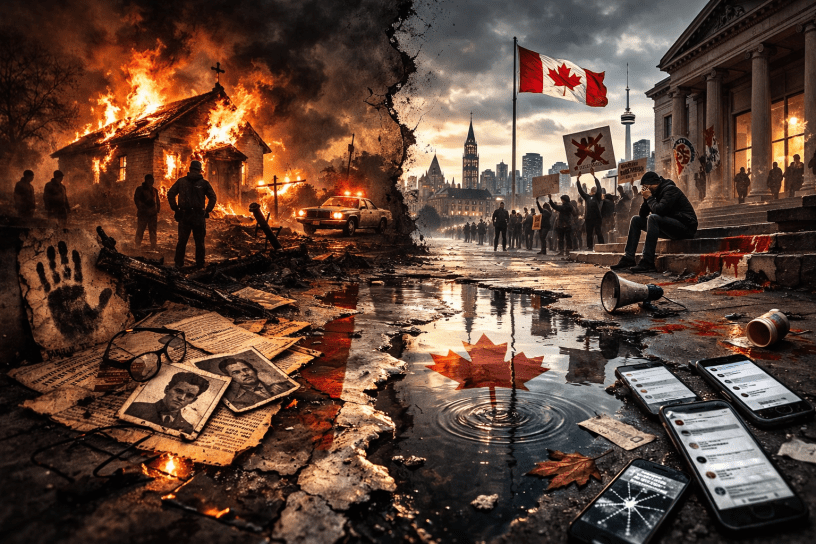
Racism is often treated as history—something already confronted, corrected, and safely sealed in the past. Watching Mississippi Burning, a dramatization of racist violence in 1960s Mississippi, makes that belief difficult to sustain. The film is unsettling not because it depicts an unfamiliar brutality, but because it exposes a moral failure that continues to reproduce itself: institutions that avert their gaze, language that strips people of their humanity, and a public conditioned to accept both as normal. Canadians often reassure themselves that this kind of violence belongs elsewhere, to another country and another time. That confidence is misplaced. When hate is granted legitimacy, when bigotry is defended as speech, and when accountability is treated as optional, societies do not drift away from violence—they rehearse it.
The film centres on the murder of three civil rights workers, but its enduring relevance lies less in the crime itself than in the system that makes it possible. The violence is not framed as spontaneous or aberrational; it is presented as the logical outcome of a social order where white supremacy is preserved through silence, fear, and institutional alignment. Law enforcement, political leaders, and ordinary citizens are shown not merely failing to intervene, but actively maintaining the conditions under which violence becomes predictable.
What struck me most is how familiar the language of hate remains. The slurs, threats, and rationalizations voiced in the film—claims of threat, disorder, and entitlement—closely resemble rhetoric still directed today at people of colour and other marginalized communities. The vocabulary may be moderated, but its function remains intact: to dehumanize, to normalize exclusion, and to render violence foreseeable rather than shocking. Language does not simply mirror prejudice; it conditions the public to tolerate its consequences.
Power in the film operates not only through brute force, but through coordination and restraint—through who enforces the law, who bends it, and who declines to act. Justice arrives slowly and incompletely, underscoring a central truth: legality and morality are not interchangeable. Institutions charged with protecting the public can just as efficiently shield harm when disruption threatens order. The film’s most disturbing message is not that racism exists, but that it persists when systems designed to confront it instead prioritize stability over justice.
This is not an argument that Canada is Mississippi in 1964—but no society arrives at that point by accident. The same dynamics are visible here at home. They surface in the normalization of hateful rhetoric online and in public spaces across Canada, including here in Niagara. Those advancing this rhetoric often insist they are merely ‘expressing opinions,‘ but history makes clear that violence is rarely sudden. It is cultivated—through language that degrades, policies that exclude, and communities trained to look away.
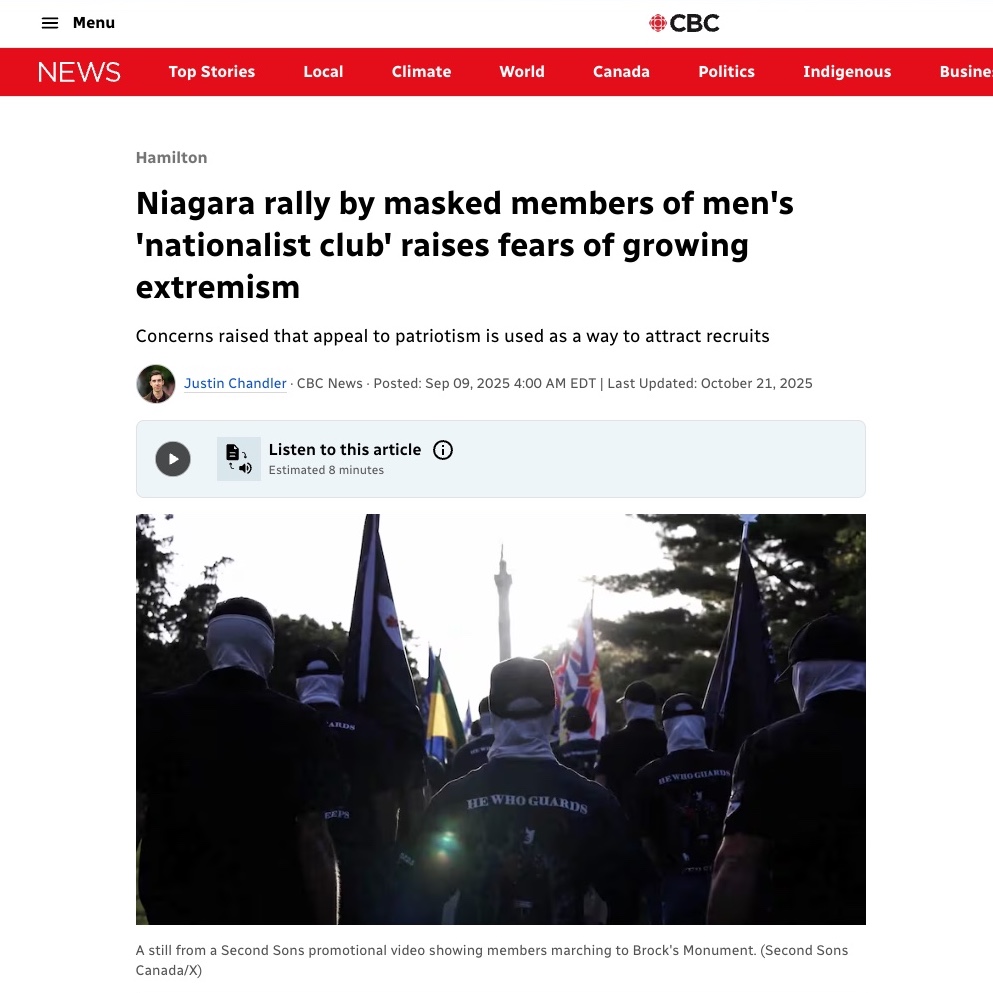
Hate does not remain narrowly focused. It expands when left unchallenged, migrating between targets—immigrants, racialized communities, religious minorities, 2SLGBTQQIA+ people—adapting its tone while retaining its purpose. Bigotry within law enforcement, the erosion of accountability, systemic discrimination, and the abuse of power are not relics of a single era or country. They persist precisely because they are allowed to.
Recent data reinforces this reality. Police-reported hate crimes in Canada have risen sharply in recent years, more than doubling since 2019. Incidents motivated by race, religion, and ethnicity continue to increase, alongside organized hostility toward specific communities. These are not abstract trends. They are visible in neighbourhoods, in public discourse, and in the willingness of some to openly advocate exclusion and violence while others dismiss it as fringe.
TO READ MORE ABOUT THE RISE IN
FASCIST FIGHT CLUBS IN CANADA CLICK HERE.
Complacency is often mistaken for neutrality, but it is neither. Silence does not reduce harm; it authorizes it. Every society that later expresses shock at its own descent into violence first perfected the habit of minimization.
The lesson of Mississippi Burning is not simply that racism once existed, but that it thrives when complacency is mistaken for progress. Societies do not wake up one morning transformed; they arrive there through a series of small, deliberate decisions—to excuse, to rationalize, to remain silent. Canada is not immune to this trajectory. If anything, our insistence that we are different may be the very condition that allows history to repeat itself—this time, closer to home.


On My Fight with the NRPS
Until now, I have carried this case largely on my own. I authored the original complaint. I survived the first major procedural hurdle. I researched and drafted a comprehensive response to the NRPS “defence”—a document prepared by a team of taxpayer-funded lawyers with decades of combined experience. I met the system where it stood, with…


On Not Disappearing
I am not good at making lifelong friends. My record is uneven, marked by distance and missed chances. Going stealth would have only deepened that pattern. More importantly, it would have meant abandoning the mercy, empathy, and action shown by the people who stood beside me. I needed their proximity—not just their support, but their…

JUSTICE ENDS WHERE POLICING BEGINS: The Shameful History of Policing The Gay and Trans Community in Canada
Policing reform is routinely framed as a matter of training, oversight, or inclusive language. None of this resolves the central contradiction exposed by decades of violence against trans people: policing is a system built on discretion, not equality. It decides who belongs, who is suspect, and whose suffering is credible.

ROT AT THE CORE: How Transphobia Persists in Niagara’s Policing Culture
The former president of the Niagara Regional Police Association exemplifies systemic transphobia and homophobia in policing, perpetuating a culture of distrust. This issue highlights accountability failures, emphasizing the need for broader community responsibility in ensuring respect and equality for marginalized groups.

STEADY, UNBROKEN: A River of Reconciliation
This piece reflects on the significance of National Day for Truth and Reconciliation, emphasizing the importance of listening to land, honoring Indigenous truths, and taking action towards reconciliation. The author highlights personal experiences along the Grand River, advocating for stewardship and shared responsibility.
 Sabrina Constance