The Object and the Illusion
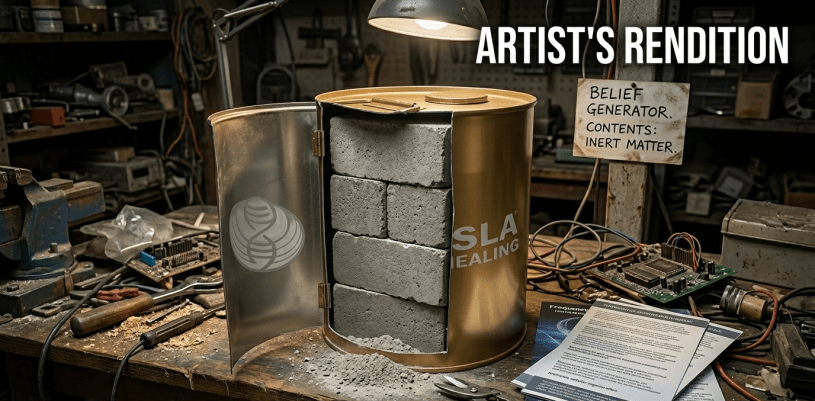
They opened the machine expecting the future—coils, circuitry, something worthy of the name “Tesla.” Instead, inside the sleek, gold‑painted “biohealing generator” marketed as a breakthrough in healing, they found a solid concrete block. Dead weight. No hidden technology, no revolutionary energy source—just the physical embodiment of a promise that was never real.
But the real story isn’t the absurdity of what was inside. It’s how many people were prepared to believe in it long before anyone bothered to look.
The so‑called “Tesla MedBed Generators,” “Tesla Biohealers,” or “biobeds”—the names shift, the pitch does not—reveal more than a single scam. They expose a culture where the aesthetics of science and a deepening distrust of expertise converge, conditioning people to mistake the appearance of knowledge for knowledge itself.
The Language of Plausibility
The device’s own promotional language tells a very different story from the concrete reality. Arrange multiple units “in a square formation,” the materials claim, and they will generate an “Ultra‑Amplified Quantum Biophoton Energy Field” capable of “promoting cellular regeneration” and “aligning with the body’s bioenergetic patterns.” The vocabulary is dense, technical, and just familiar enough to feel plausible. It borrows the rhythm of science without submitting to its discipline.
“It borrows the rhythm of science without submitting to its discipline.”
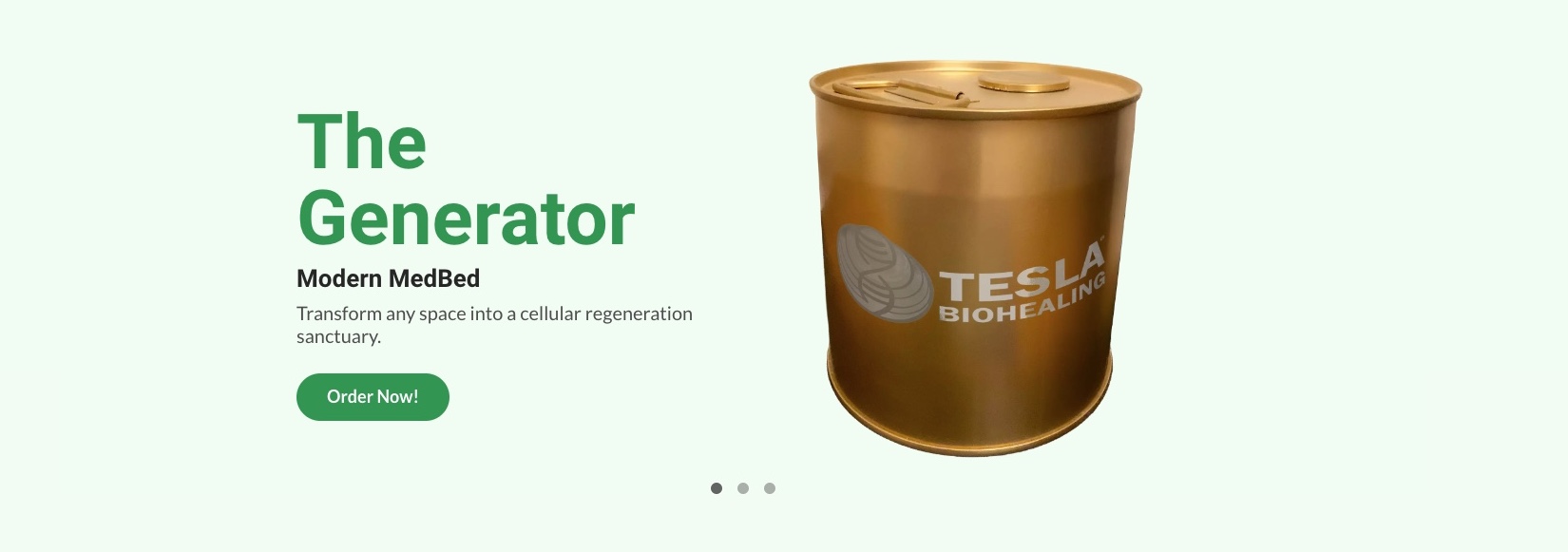
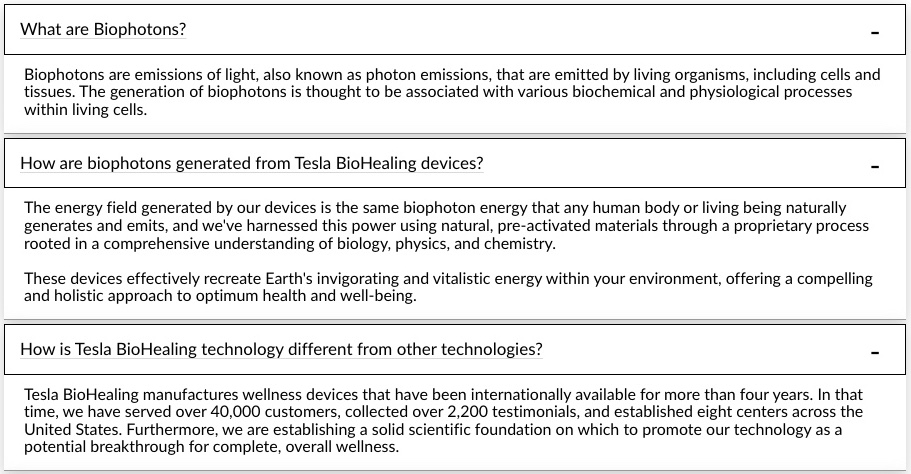
Set against the inert blocks inside the casing, the effect is almost surreal. The language promises motion—frequency, amplification, transformation—while the object itself is static, unchanging, dead. If the device generates any field at all, it is not energy but belief.
And that is what makes the image linger. The concrete is not just a punchline; it is a metaphor. On the surface, the device appears technical, advanced, even revolutionary. Beneath that surface, nothing is doing the work—only the weight of assertion, stacked and reinforced until it feels solid enough to stand on.
In a narrow sense, the product may even fulfill one of its implied promises: durability. Concrete blocks sealed inside welded metal will likely outlast many of the claims made about them. Long after the marketing language shifts and the next breakthrough is announced, the contents will remain exactly as they are—unchanged, unresponsive, and entirely indifferent to the bodies arranged around them.
If the Tesla Biohealers were only an object, it would be easy to dismiss—an overpriced curiosity, a particularly brazen example of modern snake oil. But objects like this do not appear out of nowhere. They sit at the end of a pathway that begins in a far more familiar place.
The Pathway to Belief
It often starts softly. A suggestion, not a claim. The idea that the body has untapped potential, that modern life has disrupted some natural balance, that there are gentler, more “holistic” ways to restore it. Detoxes. Energy healing. Biofrequency devices. The language is careful—non‑threatening, intuitive, just technical enough to feel informed. Nothing demands belief outright. It invites it.
From there, the shift is gradual. If the body can be healed in ways mainstream medicine does not recognize, perhaps ‘mainstream medicine is incomplete.’ If incomplete, perhaps it is ‘withholding something.’ And if it is withholding something, then the institutions behind it—pharmaceutical companies, regulators, researchers—begin to look less like authorities and more like obstacles. “Alternative” becomes “suppressed.” “Holistic” becomes “hidden.” “They don’t want you to know.”
By the time a product like the Tesla MedBed Generator enters the picture, the groundwork is already laid. It does not need to prove itself. It only needs to fit—to echo the language, affirm the suspicion, and reinforce the sense that the user is now operating just outside the boundaries of conventional understanding. Terms like “frequency,” “energy,” and “quantum” circulate without definition, gaining weight through familiarity rather than meaning.
What emerges is not belief in a single device, but a shift in how knowledge itself is evaluated. Evidence becomes negotiable. Expertise becomes suspect. Personal conviction, repeated often enough and supported by the right vocabulary, begins to carry the authority that data once did. From there, the expansion is not a leap but a continuation: from distrust of medicine to distrust of institutions, from skepticism to certainty, from wellness to ideology.
This is why the Biohealers matters. Not because it is convincing, but because it rarely has to be. It sits at the far end of a pipeline that conditions people to replace verification with intuition and to mistake the language of science for science itself. By the time the concrete is revealed, the belief it was meant to support is already firmly in place.
But belief alone is rarely enough. It must feel meaningful. It must feel like a choice.
These products offer more than their stated function. They offer identity. Not just someone trying to be healthier, but someone who has seen through something—someone who understands what others do not. The appeal is not simply therapeutic; it is positional.
When Belief Becomes Identity
Rejecting conventional medicine is framed not as risk, but as independence. Adopting alternative devices becomes a ‘quiet act of resistance.’ You are no longer a passive participant in a flawed system; you are an active agent reclaiming control. You are thinking for yourself. You are doing your own research.
For many, that posture answers a deeper need. In a world where people feel ignored, dismissed, or constrained—by institutions, by economics, by lived experiences of marginalization—the act of saying no can feel like the only available form of control. Skepticism hardens into identity. Resistance becomes agency.
This framing is not unique to biohealer‑style devices. It appears across miracle supplements marketed as “natural alternatives,” anti‑vaccine detox regimens, frequency stickers, wearable patches, even off‑grid survival gear sold alongside narratives of institutional collapse. The specifics vary, but the message is consistent: the world you’ve been told to trust is unreliable, and what you are buying is not just a product but a way out.
In this context, the purchase becomes symbolic. It signals not just belief, but alignment. The object—device, supplement, protocol—becomes a marker of belonging to a group that sees itself as informed, aware, resistant. The more mainstream institutions reject these claims, the more that rejection is reinterpreted as confirmation. Opposition becomes proof. Doubt becomes validation.
Facts struggle to compete. They are slower, more conditional, less emotionally satisfying. What replaces them is something more immediate: the feeling of autonomy, the reassurance of certainty, the comfort of community. The appeal is not that these products work, but that believing in them means something.
And once belief becomes identity, it becomes difficult to dislodge.
Intelligence alone does not protect against this. Some of the most enthusiastic adopters of devices like the Tesla Biohealers are highly capable people. What makes them susceptible is not stupidity—it is the human need for control, meaning, and belonging in a world that often offers neither.
The Performance of Authority
Another accelerant is the illusion of authority. Promoters of these devices often occupy the margins of legitimate medical professions—under‑ or unqualified practitioners who borrow fragments of credibility to claim expertise far beyond their training. A chiropractor dabbling in cellular therapies, a naturopath pontificating on genetics, a wellness influencer presenting themselves as a biomedical innovator. They occupy the space between knowledge and grift.
For someone already primed to distrust conventional healthcare, these endorsements can be persuasive. If a “health professional” is promoting a device, it must have merit. The apparent authority substitutes for actual expertise. Credentials are cited, but their depth and relevance are not. Claims are made, but the ability to verify them is absent. Belief seeks validation, and validation is supplied by those least equipped to provide it.
At its core, the psychology is simple: uncertainty is uncomfortable. Faced with complex health systems or opaque institutions, people gravitate toward answers that are simple, accessible, and immediate. A device that promises energy, regeneration, or realignment is not just a product—it is a mechanism of agency.
Belief also signals identity. To adopt one of these devices is to declare, “I see what others cannot.” It confers status within a community that values vigilance and skepticism. In a social environment mediated by likes and shares, this reinforcement magnifies overconfidence. Exposure becomes mastery. Repetition becomes verification. Social affirmation becomes truth.
Historical and systemic failures add another layer. Distrust is not invented—it is inherited. Medical racism, pharmaceutical scandals, and public health missteps have eroded confidence in institutions. For some, skepticism is rational; for others, it is an understandable shortcut.
The Psychology of Certainty
But intelligence is not wisdom. Wisdom requires interrogating assumptions, recognizing historical patterns, and resisting the seductive simplicity of plausible‑sounding claims. Anyone who engages that process can see that the Tesla Biohealer is not a revolution but the latest iteration of a centuries‑old pattern.
Wisdom requires interrogating assumptions, recognizing historical patterns, and resisting the seductive simplicity of plausible‑sounding claims.
This is not about gullibility. It is about psychology, context, and the interplay between knowledge, identity, and emotion. Intelligence can inform, but without critical thinking and a grounded epistemology, even smart people can fall for systems built to make them believe in the unseen, the untested, and the nonexistent.
The Aesthetics of Science
Once belief is secured, the next step is persuasion by appearance. These devices do not need to work—they only need to look scientific. Terms like “frequency,” “biophoton,” “quantum,” and “Tesla energy” are sprinkled liberally. Diagrams of interlocking geometric patterns or coils of unspecified purpose give the impression of complexity.
The invocation of Nikola Tesla is no accident. Tesla has long been cast as the misunderstood genius, the outsider whose brilliance was unrecognized. For many who fall for these scams, this mirrors their own sense of marginalization. They see themselves as outsiders capable of recognizing truths the mainstream cannot.
Enter Elon Musk, the modern emblem of technological genius, whose personal mythos has been carefully rewritten from spoiled child and privileged scion to lone visionary outsider, revolutionizing entire industries. In reality, much of the spectacle is far less glamorous: second-rate electric cars with bulletproof bodies that remain baseball-susceptible, tunnel boring machines that go nowhere, and mimes dressed in two-tone skin-tight nylon suits awkwardly dancing to Muzak. Yet this curated image of genius—brilliant, contrarian, fearless—lends symbolic authority to any claim invoking Tesla, reinforcing the idea that brilliance is always just outside conventional recognition, and that the system is blind to what only a select few can see.
This symbolism dovetails with broader cultural patterns. Post‑COVID, susceptibility to devices like the biohealer overlaps with certain ideological tendencies—skepticism of regulation, distrust of scientific consensus, emphasis on individual autonomy. The allure is psychological: a promise of insight and control in a world perceived as corrupt or incomprehensible.
Epistemological Camouflage
What is happening here is epistemological camouflage. The device does not reject science—it imitates it. Language, diagrams, and historical symbolism create a façade of rigour. Underneath, there is no testing, no replication, no peer review—just assertion and repetition. Plausibility masquerades as proof.
The device does not reject science—it imitates it.
The Biohealer is not a device that heals the body. It is a machine that manufactures belief.
And it thrives because most people were never taught how to evaluate claims in the first place. Public education emphasizes memorization over inquiry. Few are taught how to weigh evidence, distinguish expertise from assertion, or recognize when scientific language is being imitated rather than applied.
The result is not ignorance—it is vulnerability. In a world saturated with information, the absence of critical frameworks leaves people exposed to narratives that exploit distrust and reward belief over verification. A block of concrete wrapped in gold‑painted tin becomes a ‘symbol of energy, healing, and hidden knowledge.’
A System Designed for Belief
Culture compounds the problem. Misinformation spreads faster than correction. Repetition masquerades as consensus. Without epistemological tools, plausibility becomes proof, and assertion becomes authority.
The problem is not individual. It is societal. People no longer agree on how we know what is true. Experts are “corrupt.” Peer review is “controlled.” Anecdotes are treated as equal—or superior—to data. Political movements exploit this vacuum, not merely to misinform, but to delegitimize the institutions that verify truth.
Where truth becomes inconvenient to the bottom line—whether for wellness industries or political power—it is erased, rewritten, or buried beneath plausibility. The vacuum rewards those willing to assert certainty without evidence.
The real story isn’t what was inside. It’s how many people were ready to believe in it.
The Tesla Biohealer is simply another expression of a deeper, longstanding pathology. The concrete inside is a metaphor for more than gullibility—it is the weight of a society trained to mistake the appearance of knowledge for knowledge itself. If people can no longer distinguish between what is real and what merely seems real, the question is no longer why scams exist, but what replaces truth when it disappears.
Read PART 2: On The Business of Belief here.
 Sabrina Constance