On Contradiction as a Feature, Not a Bug
Pseudoscientific miracle cures thrive on contradiction. They reject science while borrowing its authority, discredit institutions while adopting the aesthetics of legitimacy — white coats, charts, clinical‑sounding trials, and technical language. Claims of “quantum energy fields” or “FDA‑registered materials” are paired with cherry‑picked studies, self‑styled experts, and professionals operating far outside evidence‑based practice. The message is always the same: science is corrupt, except when it can be exploited.
“Do your own research” (DYOR) is the mantra that binds these communities. It promises empowerment but functions as control. Followers are encouraged to verify everything — but only within the boundaries the grifter defines: YouTube clips, curated testimonials, selective articles, influencer monologues. Skepticism is reframed as hostility, negativity, or evidence of being “brainwashed by Big Pharma.” The result is a closed epistemic loop:
DYOR → consume curated misinformation → feel empowered → trust the grifter more → reject outside correction.
‘Do your own research’ promises empowerment but functions as control.
Overconfidence and distrust make this loop powerful. People naturally overestimate their ability to evaluate complex scientific claims, and low trust in science correlates strongly with susceptibility to pseudoscientific promises. Grifters exploit this cognitive bias, flattering audiences with messages like, “You’re smarter than the sheeple. You see the truth.” Doubt becomes weakness; belief becomes strength. Those who question the claims are framed as naïve, compromised, or complicit.
On Manufactured Authority
Distrust of experts is sold as virtue, while blind faith in self‑appointed “gurus” is framed as insight — turning skepticism into obedience and independence into submission. Chiropractors, naturopaths, wellness coaches, MLM health ambassadors, and self‑proclaimed researchers provide the theatre of legitimacy. They offer clinical‑sounding language, testimonials dressed as evidence, and a shield against scrutiny. Challenge them, and you are shamed, silenced, or accused of being part of a larger conspiracy.
Communities form around these figures, and social reinforcement becomes a powerful accelerant. Questioning the dominant narrative is discouraged, mocked, or punished. Repetition becomes the mechanism of belief. Daily testimonials, recycled “studies,” and motivational posts embed claims into identity. The more often a statement is encountered, the more it feels true. Cognitive fluency turns repetition into perceived fact. The same claims echo across short videos, memes, diagrams, and forums — appearing in different forms but carrying the same meaning. Even those who initially doubt begin to feel its pull. Familiarity erodes resistance; certainty becomes ambient.
Distrust of experts is sold as virtue, while blind faith in self‑appointed “gurus” is framed as insight — turning skepticism into obedience and independence into submission. Chiropractors, naturopaths, wellness coaches, MLM health ambassadors, and self‑proclaimed researchers provide the theatre of legitimacy.
The hypocrisy is everywhere: anti‑regulation rhetoric paired with vulnerability to unregulated scams; anti‑elite sentiment paired with unquestioning trust in self‑proclaimed insiders selling products; skepticism toward credentialed experts paired with reverence for influencers with no scientific training. Authority is performed, not earned. Evidence is simulated, not verified. The effect is psychologically compelling, socially reinforced, and financially lucrative. The grift is not just a product or a promise — it is a system built to exploit desire, identity, and trust.
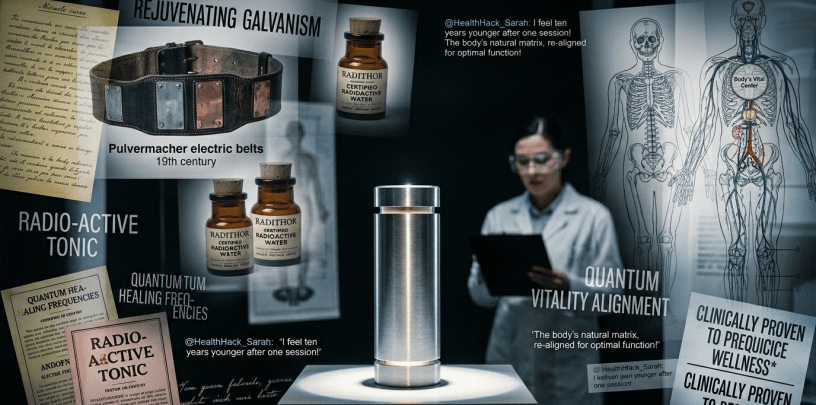
Look closely at the history of miracle cures, and a pattern emerges that is both predictable and unnervingly human. The devices evolve, the jargon updates, the packaging gets sleeker — but the appeal never really changes. The people buying Tesla Biohealers today, convinced that metal cylinders filled with “life force energy,” whatever that means, can “regenerate cells,” are spiritual descendants of the 19th‑century customers who strapped on Pulvermacher Galvanic Chains or drank Radithor by the bottle.
This isn’t an insult. It’s an observation about psychology — and about how easily it can be manipulated by the same marketing tropes, generation after generation.
In the 1880s, the Pulvermacher Galvanic Chain was all the rage. Promised to cure “nervous exhaustion” and “female weakness,” it came with technical diagrams, glowing testimonials, and claims that electricity itself could heal the body. The belt barely produced a measurable current. It didn’t need to. Electricity was new, mysterious, and powerful. Customers weren’t foolish — they were overwhelmed by a technology they didn’t understand, sold by people who knew exactly how to exploit that gap.
A few decades later, radioactivity became the frontier. Radithor, marketed as “Certified Radioactive Water,” promised vitality and longevity. Wealthy industrialist Eben Byers drank so much that his bones literally disintegrated. His death was scandalous, but thousands had already bought in. Why? Because the marketing was familiar: diagrams, authority, and the promise of a simple, universal cure. Swap “radioactivity” for “quantum energy,” and the pitch is identical.
The through‑line isn’t technology — it’s psychology: awe for new discoveries, a craving for simple solutions to complex problems, distrust of institutions paired with trust in charismatic outsiders, the sense that innovation is being suppressed, and a preference for anecdotes over evidence. These aren’t demographic quirks. They’re human traits. And they make people vulnerable to the same promises century after century.
Tesla Biohealers fit this pattern perfectly. Scientific‑sounding jargon (“biophotonic energy,” “cellular regeneration”), textbook‑style diagrams, testimonials dressed as clinical evidence, appeals to “suppressed knowledge” — all repackaged in brushed aluminum and wellness aesthetics. Pulvermacher Chain. Radithor. Modernized. Same formula.
Once you recognize the continuity, the modern extremes stop being shocking. Some believed a horse dewormer could treat a viral infection. Some believed vaccines carried Bluetooth microchips. Some believe a metal cylinder can emit life force energy. These aren’t anomalies. They are the logical evolution of a long tradition: techno‑mystical marketing aimed at those alienated from mainstream science but still drawn to the authority of scientific language.
On Repetition and the Making of Truth
The past isn’t just prologue — it’s the blueprint. Miracle cures didn’t vanish. Their audiences didn’t vanish. The marketing didn’t vanish. It got better. The technology changes. The packaging changes. The psychology — and the vulnerability — remains exactly the same.
Miracle cures didn’t vanish. The marketing got better.
Who Gets Hurt When Pseudoscience Thrives? It’s easy to smirk at “quantum healing stickers” or brushed‑aluminum cylinders marketed as Tesla Biohealers. But the joke is only skin‑deep. The damage is real, measurable, and often permanent. Behind every miracle cure is a trail of emptied wallets, delayed treatment, fractured families, and eroded trust.
On the Cost of Belief
Money is the first casualty. Biohealers cost thousands for a metal cylinder infused with…whatever passes for “life force energy.” Families drain savings, max out credit cards, crowdfund the impossible. It’s not a bug; it’s the business model. Eben Byers spent a fortune on Radithor before it dissolved his bones. Today, GoFundMe campaigns fund unproven cancer cures, detox regimens, and “frequency therapy” devices. Different century. Same pattern.
Time is crueler. False hope replaces medicine, and the clock never stops. During COVID‑19, some people took ivermectin instead of seeking proper care. Hospitals saw critically ill patients; poison control centres were flooded with calls about veterinary‑grade doses. A century ago, it was radioactive tonics. Today, it’s biofrequency patches. The tools change. The consequences do not.
Pseudoscience isn’t just a personal risk — it’s a public one. Misinformation erodes trust, fractures shared reality, and weakens public health. Vaccine conspiracies didn’t stay online; they slowed uptake and created real‑world harm. Electric cure‑alls in the 1800s undermined faith in emerging medicine. Radium water in the 1920s blurred the line between science and danger. Now social media spreads false cures faster than any correction can catch up.
And then there’s the social toll. Belief becomes identity. Families fracture over miracle devices, detox regimens, or conspiratorial health narratives. During the pandemic, some refused to see vaccinated relatives. Others cut ties with loved ones who “fell for the lies.” Online wellness communities tighten the loop: skepticism is punished, affirmation rewarded, doubt becomes betrayal. Subcultures around pseudoscience aren’t new — they’ve existed since electric belts — but today, digital echo chambers make them far stickier.
Belief becomes more than opinion — it becomes identity.
The stakes are simple. People lose savings. People delay treatment until it’s too late. Communities lose trust in public health. Families lose each other. The miracle cures change. The harm does not.
On the Price We Pay
The Bottom Line: Belief Isn’t Free. Pseudoscience thrives because it trades on human psychology, not truth. It exploits awe for the novel, distrust of institutions, and hope for the desperate. It borrows the language of science, the aesthetics of authority, and the rhythms of social reward — all while delivering nothing that actually works.

The cost is real. It comes in dollars drained from savings, in treatments delayed until it’s too late, in communities fractured by misinformation, in trust eroded until the idea of shared reality feels fragile. Every miracle cure that fails, every “quantum” or “bioenergy” gimmick, isn’t just a joke — it’s a tangible wound.
This is the pattern across centuries. Electric belts. Radioactive tonics. MLM wellness products. Metal cylinders and life‑force devices today. The players change, the technology changes, but the psychology and the harm do not. People have always been drawn to simple solutions, authoritative‑sounding promises, and the illusion of insider knowledge. That attraction is constant. The consequences are predictable.
What we are witnessing now is the industrialization of that pattern. Algorithms, social media platforms, and influencer ecosystems have scaled it to a global audience. Belief is packaged, amplified, monetized, and reinforced. The stakes are no longer just personal — they are societal.
And here’s the uncomfortable truth: belief is rarely innocent. It is sold, performed, and weaponized. Nothing about it is free. Not your money. Not your time. Not your health. Not your family. Not your trust.
If there is a single takeaway from this series, it is this: when belief becomes a product, the cost is never abstract — and the buyer is always human.
When belief becomes a product, the cost is never abstract.
Belief isn’t harmless. It costs money, time, health, and trust — and once it’s been sold, there’s no receipt.

On Not Disappearing
I am not good at making lifelong friends. My record is uneven, marked by distance and missed chances. Going stealth would have only deepened that pattern. More importantly, it would have meant abandoning the mercy, empathy, and action shown by the people who stood beside me. I needed their proximity—not just their support, but their…


I DIDN’T PLAN TO BECOME A TEACHER: The Students Who Made Me Stay
I didn’t become a teacher because I planned to. I became one because I stayed. Because I said yes often enough. Because students like Alex and Clare taught me that education is not merely academic—it is relational, fragile, and profoundly human.

RAISED BY PLACES UNSEEN: The Quiet Way Borneo Found Me
I arrived in Kota Kinabalu under a veil of night. The airport was modest, its walls carrying a patina of age that felt unexpectedly comforting. It didn’t strive to impress; it felt lived-in, a doorway used by generations of travellers before me.

PART 3 – NO PERMISSION NEEDED: What Was Once Shame Has Become Pride
What began as innocent play, the joy of dressing up and pretending, soon curdled into confusion and punishment. My parents’ gentle corrections hardened into anger, their voices faltering with something more akin to unrelenting impatience. My pleas — small, wordless, desperate — were dismissed as misbehaviour. How could I have explained, at four or five…

PART 2 – SHAPE OF BECOMING: Grief, Legacy, and Inheriting Her Echo
Grief is a complex journey, shaping identity through loss and memory. Sabrina reflects on her relationship with her mother, navigating absence, longing, and legacy. While struggling to inherit her traits, they ultimately find strength and validation in her mother’s enduring voice, guiding them towards self-acceptance and growth.

PART 1 – UNFOLDING: A Trans Woman’s Search for Self and Sanctuary
In Canada, before I left, I moved through the world like a ghost—trapped in the wrong name, the wrong body, the wrong silence. In Korea, in this unexpected corner of Asia where cities shed memory as quickly as the seasons change, I found a stillness that held me. Through my camera lens, through hours of…
 Sabrina Constance
Comments are closed.