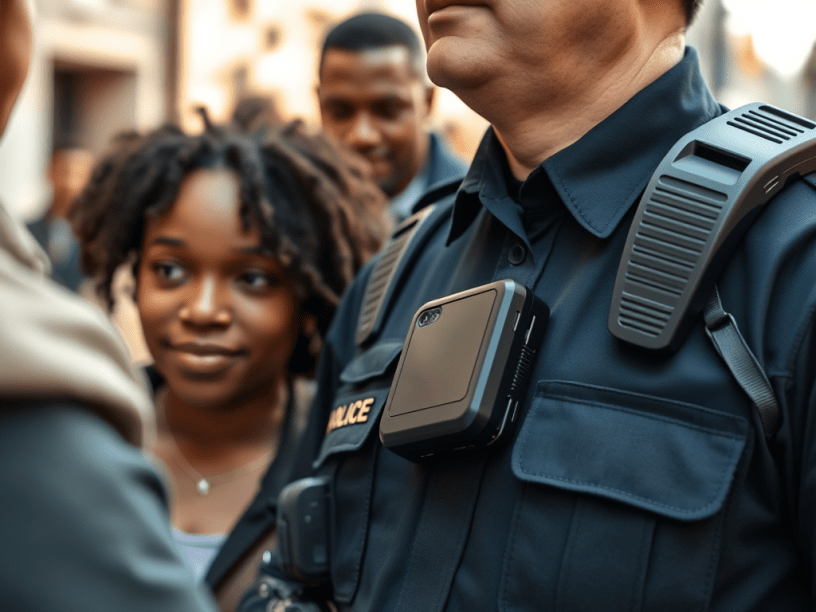
WHAT ARE BODY-WORN CAMERAS?
Body-worn cameras (BWCs) are small, portable devices typically worn on the body (often attached to the chest or shoulder) by law enforcement officers, security personnel, or other professionals. These cameras are designed to record video and audio of interactions between the wearer and members of the public or suspects. The primary purpose of body-worn cameras is to enhance transparency, accountability, and trust in interactions between law enforcement and the community.
KEY FEATURES OF BODY-WORN CAMERAS:
- Video and Audio Recording: BWCs capture visual and auditory evidence during interactions. This is crucial for documenting encounters and can be used as evidence in legal proceedings or investigations.
- Real-time Documentation: The recordings can capture events as they unfold, helping to create an accurate, unbiased record of what occurred.
- Activation Methods: Body cameras may be activated manually by the wearer or automatically triggered by specific events (e.g., the drawing of a weapon, high-intensity situations, or after an officer exits a vehicle).
- Storage and Data Management: The footage captured by body cameras is usually uploaded to a secure cloud server or local storage system. There are protocols for managing, storing, and releasing the data in accordance with laws and departmental policies.
- Design: The devices are typically lightweight, durable, and designed to be unobtrusive. Many are weather-resistant to withstand various environmental conditions.
MY ADVOCACY FOR MORE TRANSPARENCY AND MEANINGFUL ACCOUNTABILITY
For more than five years, I have passionately championed the need for Body-Worn Cameras (BWCs) within the Niagara Regional Police Service (NRPS). This initiative became a cornerstone of my campaign when I ran for office in 2022. Throughout this journey, I’ve faced a barrage of evasive replies from their public relations coordinator, who conjures up every excuse imaginable to sidestep the real issue: a desire to remain opaque and evade accountability. Witnessing this resistance is frustrating when transparency and accountability are key to building trust in our police service.
BENEFITS OF BODY-WORN CAMERAS:
- Accountability: BWCs can serve as a deterrent against inappropriate behaviour, ensuring that officers and individuals act professionally.
- Evidence Collection: They provide valuable visual and audio evidence for investigations and court proceedings.
- Transparency: BWCs help to build trust between law enforcement agencies and the public by providing an unbiased record of events.
- Conflict Resolution: Recorded footage can help resolve disputes or complaints, potentially reducing the number of false claims or allegations against officers.
BWCs represent the possibility for a new type of policing in which transparency and, thus, accountability are front and centre. Officers would have to change the nature of their interactions. They would always need to be on their best behaviour, a considerable departure from the standard operating procedure for our local police service.
It’s undeniable that Body-Worn Cameras (BWCs) are essential for several reasons: accountability, transparency, deterrence of misconduct, public safety, training and improvement, and evidence collection. Overall, they are a valuable tool for enhancing the integrity and effectiveness of law enforcement.
BWCs promote accountability among law enforcement officers and the public. They provide an objective record of interactions, which can help ensure appropriate behaviour. Knowing they are being recorded can discourage officers and civilians from engaging in inappropriate behaviour. BWCs enhance transparency in policing, helping to build trust between law enforcement and communities. They provide a clear record of events, which can clarify disputes. And finally, BWCs can help improve public safety and inform policy decisions by providing more accurate accounts of incidents.
The Regional Municipality of Niagara has no interest in overseeing the operation of our police force. The Police Service Board (PSB) for the NRPS is a statutory requirement but does nothing to drive public safety, accountability, or improve community relations. Its members are almost exclusively pro-police, appointed to ensure the status quo.
MEANINGFUL CIVILIAN OVERSIGHT
The justification for civilian oversight (wholly different from the current local PSB model) in policing almost perfectly overlaps with the rationale for BWCs. Civilian oversight helps hold law enforcement agencies accountable for their actions. Independent review can identify misconduct and ensure officers are held responsible. Oversight promotes transparency in policing practices. It allows the public to see how police actions are reviewed and addressed, fostering trust between the community and law enforcement. Civilian oversight helps build trust within communities, particularly marginalized groups. When civilians oversee, the police are committed to listening to community concerns. It empowers citizens by giving them a voice in overseeing police practices, ensuring that community values and concerns are considered in law enforcement operations.
Through that model for oversight, we are beginning to understand why the Niagara Regional Police Service is disinclined to accept BWCs and civilian oversight.
CRITICISMS AND CHALLENGES:
- Privacy Concerns: There are concerns about the balance between privacy rights and transparency, especially regarding the recording of private individuals and sensitive situations.
- Technical Issues: Cameras may malfunction, run out of battery, or fail to record critical moments due to manual errors or technical glitches.
- Data Management: The storage, security, and access to recorded data must be handled carefully to avoid misuse, leaks, or mishandling of footage.
- Cost: Law enforcement agencies can find body-worn cameras expensive to purchase, maintain, and store initially.
Civilian oversight bodies can recommend policy changes and improvements, helping law enforcement agencies adopt best practices that enhance effectiveness and fairness. By addressing issues such as excessive force or discrimination, civilian oversight can lead to better policing practices, ultimately improving public safety for all community members.
While the NRPS hosts costly events inviting a small, curated group of civilians to “police school,” a workshop that exists only to show how “tough it is to be a cop,” the Chief of Police (Bill Fordy) dodges any real chance for oversight and technology-assisted transparency. “Open” Houses where ‘cops vent about their jobs‘ are far more medicinal for the police, particularly the executive command branch, than actual reform and accountability. These “police school“/open houses are a silly distraction from being open, transparent, and accountable.
Although the NRPS has never had more resources than it does now, it has found justifications to avoid the deployment of this accessible technology, usually complaining about either the “cost” or the “privacy concerns” while pushing ahead with the (expensive) rollout of Automatic Licence-Plate Recognition/Readers (ALRPs), which scan hundreds of plates a minute. That technology, ALRPs – hardware that has devastating consequences on privacy – is much more ‘the gem of the NRPS’ eye’ as they will not derail careers through a more transparent complaint process. The service has no issues with your data being collected; only the data (meaning the conduct and actions of its front-facing, uniformed constables) is being collected, stored, and subject to oversight. Without a doubt, BWCs pose an existential threat to the economic outcome of (our) overpaid police constables, and for this reason, BWCs are a bridge too far.
GOING FORWARD
Given that numerous police services in Ontario and Canada have already implemented BWCs, the resistance from the Niagara Regional Police Service will likely diminish over time. Inevitably, the NRPS will eventually have to adopt this technology. However, based on my discussions with the NRPS, the footage will be difficult to access, heavily redacted, and come with a hefty price tag (for MFIPPA requests). The Niagara Region and the NPRS are known for their lack of transparency, so even with the introduction of BWCs, the service will likely find ways to shield instances of police misconduct. Our elected officials and our unelected, ineffective PSB are unlikely to take meaningful action to advocate for improved policing.
There is a growing anticipation that our police force will soon need to adapt to the demands of 21st-century policing. As it stands, the Niagara Regional Police Service seems to be anchored in an old-boys club mentality, reminiscent of sheriffs from 80’s TV shows in small towns, operating with a level of autonomy that often results in reports that don’t quite capture the reality of the situation. However, there is a pivotal opportunity for municipal and provincial elected officials to champion increased accountability, transparency, training, and oversight. With the elections just two years away, I am hopeful that the city will make more informed choices at the ballot box, opening the door for meaningful reform and progress.
JUSTICE ENDS WHERE POLICING BEGINS: The Shameful History of Policing The Gay and Trans Community in Canada
Policing reform is routinely framed as a matter of training, oversight, or inclusive language. None of this resolves the central contradiction exposed by decades of violence against trans people: policing is a system built on discretion, not equality. It decides who belongs, who is suspect, and whose suffering is credible.


ALONE AGAINST THE SYSTEM: Fighting Police Misconduct in Ontario Means Surviving It
In Ontario, holding police accountable isn’t a matter of justice — it’s an act of endurance.

ROT AT THE CORE: How Transphobia Persists in Niagara’s Policing Culture
The former president of the Niagara Regional Police Association exemplifies systemic transphobia and homophobia in policing, perpetuating a culture of distrust. This issue highlights accountability failures, emphasizing the need for broader community responsibility in ensuring respect and equality for marginalized groups.
 Sabrina Constance