
The system isn’t broken — it’s designed to outlast you.
In Ontario, holding police accountable isn’t a matter of justice — it’s an act of endurance. The agencies built to investigate misconduct aren’t guardians of truth; they’re architects of delay. Behind their polished promises of transparency lies a bureaucratic labyrinth built to exhaust, isolate, and ultimately silence the very people it claims to serve.
The first thing they tell you is to trust the process. It sounds simple enough: file your complaint, wait for the investigation, let the system work. What they don’t tell you is that the process isn’t built for truth. It’s built for time. Every form, every unanswered email, every polite delay serves a single purpose — to outlast you.
I used to believe accountability meant justice. That if you brought evidence, patience, and a little faith, the truth would eventually win out. But in Ontario, justice doesn’t live inside police oversight bodies — it survives in spite of them. The institutions created to investigate misconduct are more concerned with protecting their own legitimacy than confronting what’s broken.
In Niagara, I learned that fighting police misconduct isn’t about winning a case. It’s about surviving the process. The system feeds on exhaustion, convincing you that silence is easier, safer, more rational. They call it procedure. I call it attrition disguised as fairness.
Heather Mackay described the LECA rebrand as “a new chapter in police oversight in Ontario,” promising transparency and public confidence. Yet the reality is far from these ideals.

When Ontario rebranded the Office of the Independent Police Review Director into the Law Enforcement Complaints Agency — LECA — it was presented as modernization. A new era of oversight. But a new name doesn’t change an old instinct: self-preservation. LECA’s true function isn’t accountability; it’s containment.
From the outside, it looks legitimate — full of words like “independent,” “transparent,” and “accessible.” There are intake portals, reference numbers, and carefully worded responses assuring you your complaint is being taken seriously. But behind the administrative language lies the oldest trick in government: process as performance. Files move, letters are sent, boxes are ticked — but nothing meaningful ever happens.
“These are not disinterested civil servants — they are custodians of a narrative that insists most police encounters are fair and lawful.”
Oversight agencies like LECA are not advocates for victims of police misconduct, nor are they neutral arbiters. They are staffed by individuals who, by virtue of privilege, proximity to power, or aspirational ties to policing, carry biases that shape every stage of the complaint process. These are not disinterested civil servants — they are custodians of a narrative that insists most police encounters are fair and lawful. Whether out of self-preservation, protection of a comfortable government position, or an unspoken loyalty to law enforcement culture, they ensure that legitimate grievances are reframed as frivolous, vexatious, or malicious.
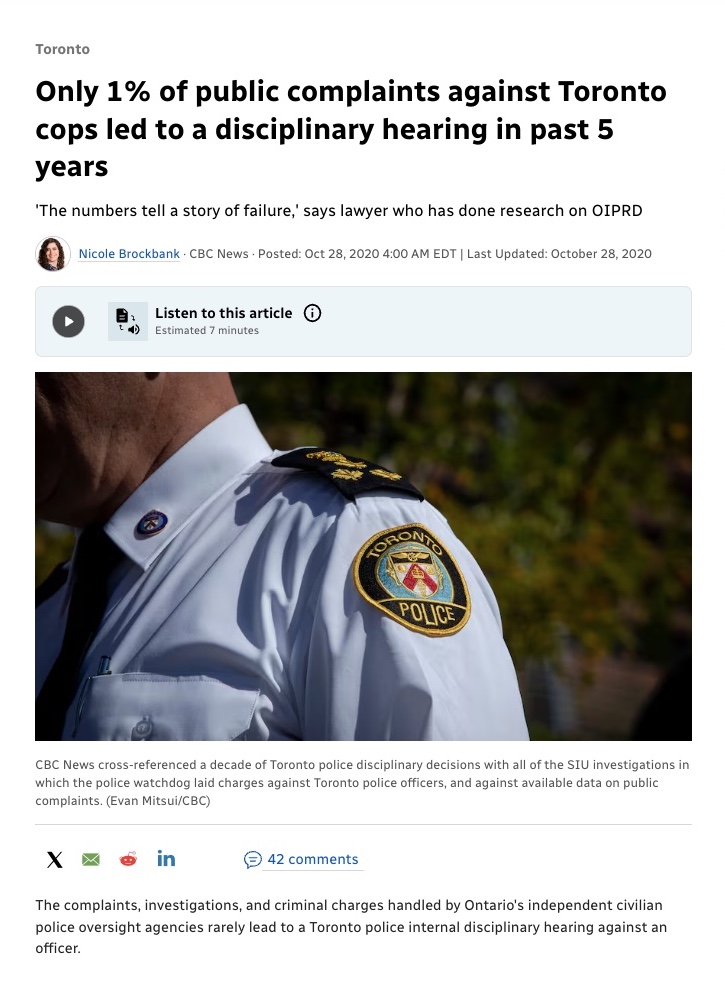
What the public rarely understands is that LECA doesn’t actually conduct investigations; it simply hands off complaints to the very police service being accused. It is the institutional equivalent of asking a bank robber to investigate their own crime. For most people, that’s a clear conflict of interest. For LECA and police services, it’s a convenient way to absolve themselves of responsibility — a bureaucratic loop that protects the profession from accountability, reform, and the reckoning it so deeply deserves.
Investigations are quietly redirected back to police services for “local resolution.” Reports vanish into procedural fog. By the time a decision arrives — often months or years later — the damage is long done, and the agency congratulates itself for having “followed due process.” Even when a complaint is substantiated, discipline is left to internal police management — the same structure that failed in the first place. Oversight, in practice, is accountability outsourced to the accused.
This is what Ontario calls independence: a mirror reflecting the image of justice while ensuring nothing truly changes. The cruelty of the system isn’t found in its decisions — it’s in the waiting. In the sterile indifference of form letters and the endless reassurance that your complaint is “under review.” This isn’t bureaucratic incompetence. It’s bureaucratic design.
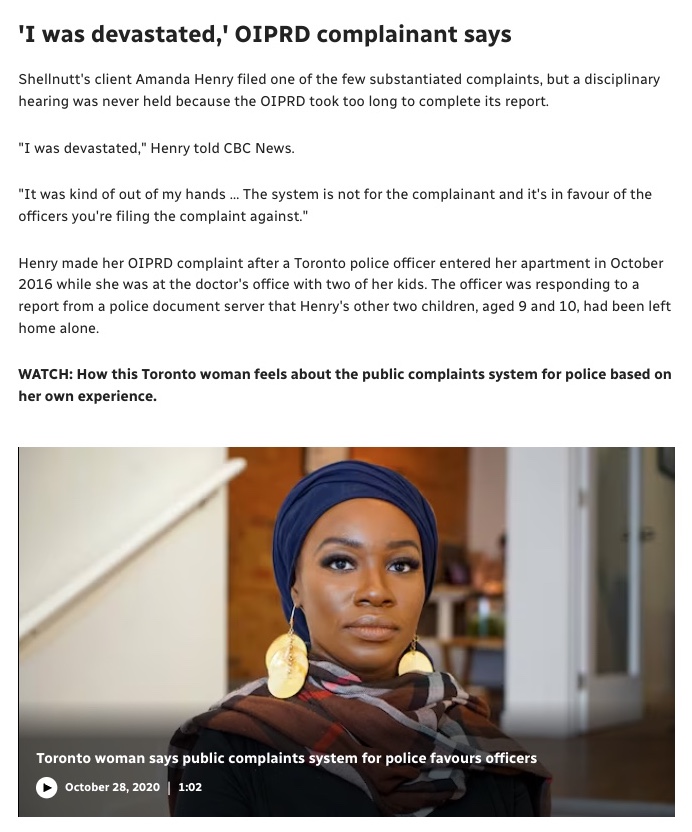
LECA operates on the logic of attrition. It isolates you, strips away momentum, and convinces you the struggle isn’t worth it. You begin the process believing in justice; you end it doubting your own memory. Each unanswered message, each missing document, each procedural loophole sends a message: we can wait longer than you can endure.
The local police service where the officer is employed often adopts the same tactic, investigating themselves — and, unsurprisingly, concluding they did nothing wrong. Even when there is video evidence of wrongdoing, LECA and the police service can make submitting that evidence difficult, deny seeing it or its existence, or use esoteric rules to dismiss it as “unfounded.”
Residents learn this quickly. Most stop trying. The absence of complaints becomes data, and that data becomes propaganda. Officials point to the low numbers as proof that police misconduct is rare, that public confidence is strong. The same silence the system manufactures becomes its defence. It’s a perfect feedback loop — one that doesn’t just protect police services, but erases their victims.
When the system can’t ignore you, it blames you. That’s the unspoken rule of oversight in Ontario: if misconduct can’t be denied, responsibility must be displaced.
“your assertion of rights as “non-compliance.” The officer’s authority is sacred; your resistance is sin.
The clerks and investigators at LECA rarely say this outright. They don’t need to. Their language does the work — subtle phrasing, selective framing, the quiet erosion of credibility. Your actions are reinterpreted as escalation, your refusal as hostility, your assertion of rights as “non-compliance.” The officer’s authority is sacred; your resistance is sin.
This is how victim-blaming becomes policy. The act of asserting your Charter-protected freedoms — to question, to refuse, to ask why — is reframed as a provocation that justifies whatever followed. You weren’t violated, they suggest. You were difficult.
LECA doesn’t invent this logic; it inherits it. Oversight staff read complaints through the same lens officers use in their reports — one where police are presumed credible and civilians are presumed suspicious. The result is a moral inversion: the complainant becomes the accused, and the system that harmed you gets to declare itself righteous for “reviewing” your pain.
There’s a moment, somewhere between exhaustion and acceptance, when you realize the system isn’t broken — it’s functioning exactly as intended. The delays, the denials, the bureaucratic fog — they’re not mistakes. They’re features. Understanding that is devastating, but it’s also clarifying. Once you see it, you can’t unsee it.
“Fighting police misconduct in Ontario isn’t about winning — it’s about refusing to disappear.”
Fighting police misconduct in Ontario isn’t about winning. It’s about refusing to disappear. It’s about documenting, speaking, and witnessing — even when you know the institution won’t acknowledge you. Each record, each statement, each photograph becomes part of a counter-archive of truth that the system cannot erase.
The endurance they demand from you becomes evidence of their cruelty. The months or years spent waiting, writing, appealing — all of it testifies to a state that measures its legitimacy by how long it can outlast the people it harms. But every time you refuse to be quiet, you expose that design. You show others what the system truly is: a carefully managed illusion of fairness.
They want you to give up so they can claim there was never a problem. Continuing — to speak, to write, to document — denies them that comfort. It is resistance in its most human form.
In the end, endurance becomes its own kind of justice. Not the justice they promised, but the justice of survival — of refusing to let truth die quietly in an inbox somewhere in Toronto. The system may outlast individuals, but every story told carves another crack in its façade. And someday, enough cracks might finally let the light in.

WHEN A PRIDE FLAG BECOMES A TARGET: The Crown V Chandler C. Robinson
A recent incident involving the vandalism of a Pride flag at a public elementary school in Thorold, led to charges against Chandler Robinson for mischief. While the act seems straightforward, it raises questions about underlying motives tied to anti-2SLGBTQQIA+ sentiments. This incident highlights how targeted actions can symbolize deeper societal issues and provoke essential discussions…


SECRECY, SURVEILLANCE, AND THE PUBLIC’S RIGHT TO KNOW: Inside the NRPS’s Secret $534,000 Technology Purchase
When Niagara Regional Police disclosed the purchase, remarkably little information accompanied the announcement. The public was informed that the expenditure had been approved and that the cost exceeded half a million dollars. Beyond that, almost nothing was provided.

THEY DEMANDED MY DEADNAME: Why I’m Taking the Niagara Regional Police Service to the Human Rights Tribunal
While filming a documentary in public, I was detained and pressured by Niagara Police to disclose my deadname—a name that no longer belongs to me. It was degrading, unlawful, and discriminatory. I’m fighting back through the Human Rights Tribunal to demand justice and dignity for all trans people.

WHEN THE COPS FEAR YOUR CAMERA: What It’s Like to Be a Trans Journalist in Ontario
Since November 2024, several constables and a few sergeants from the Ontario Provincial Police have dedicated hundreds of hours and significant resources to investigating and harassing me.
How Authoritarian Policies Fail the Unhoused in St. Catharines
The City of St. Catharines faces escalating homelessness under Mayor Mat Siscoe and administrator David Oakes, who promote punitive measures instead of meaningful solutions. Their actions reflect a disregard for the unhoused, showcasing a deeper societal failure to address the root causes of homelessness.
- MAT SISCOE AND THE POLITICS OF THE GM SITE: How St. Catharines Keeps Setting the Table for BayShore
- POLICING THE CRITIC: A Story About NRPS Priorities
- WHEN A PRIDE FLAG BECOMES A TARGET: The Crown V Chandler C. Robinson
- SECRECY, SURVEILLANCE, AND THE PUBLIC’S RIGHT TO KNOW: Inside the NRPS’s Secret $534,000 Technology Purchase
- On the Failure of Escape

