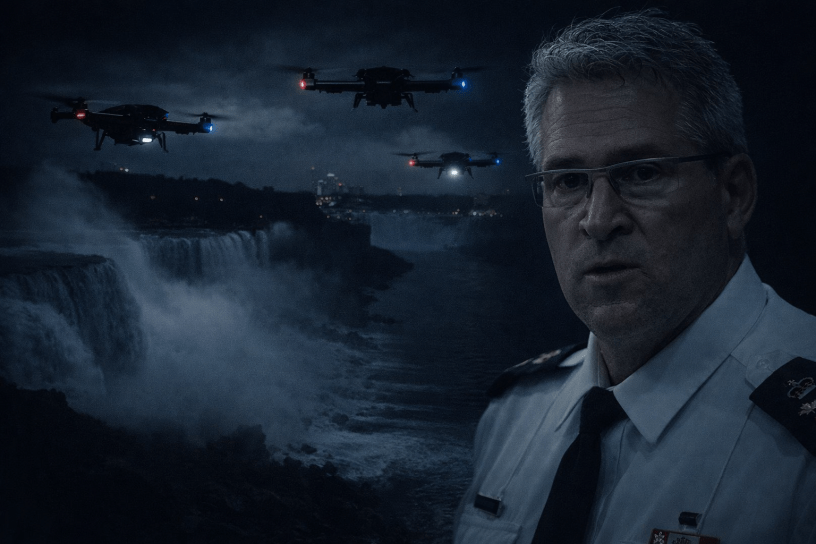
The controversy surrounding Niagara Regional Police Service’s recent $534,650 purchase is not ultimately about drones. Nor is it primarily about the technology itself. It is about transparency, public accountability, and the increasingly common expectation that taxpayers should accept significant public expenditures without meaningful public scrutiny.
Recent reporting by Allan Benner of the St. Catharines Standard revealed that Niagara Regional Police approved the purchase of an “unmanned aircraft system” through a closed-door meeting of the Niagara Police Services Board. As Benner reported, “The NRP did not respond to questions about the vendor, manufacturer or number of drones being purchased. Police are spending $534,650 for an unmanned aircraft system, but keeping the details a secret.“
The reporting aligns with confidential documents shared with this author over the past year, as well as records that were inadvertently published more recently.
When Niagara Regional Police disclosed the purchase, remarkably little information accompanied the announcement. The public was informed that the expenditure had been approved and that the cost exceeded half a million dollars. Beyond that, almost nothing was provided.
As Benner further reported, Police Services Board member Pat Chiocchio attempted to ask questions regarding the purchase during a public meeting, only to be told that discussion would need to occur during the in-camera portion because the matter had originally been considered behind closed doors.
Requests for basic details—including the identity of the vendor, the manufacturer of the equipment, and the quantity of units purchased—were declined. Police justified this secrecy by citing concerns related to “operational procedures” and “policing techniques.”
While certain operational details may legitimately require protection, the scope of the secrecy surrounding this purchase is difficult to reconcile with principles of public accountability. The identity of a vendor is not an operational secret. The rationale for a procurement decision is not an operational secret. The decision to sole-source a contract worth more than half a million dollars is not an operational secret. These are matters of governance and public administration, and they are precisely the kinds of decisions that citizens in a democratic society should be able to examine.
The secrecy surrounding this procurement has made it impossible for the public to assess whether that scrutiny occurred. As a result, attention has shifted away from the technology itself and toward the process by which it was acquired. This is a predictable consequence of withholding information. When institutions decline to provide basic explanations, speculation inevitably fills the vacuum.
At least one NRPS sergeant has been alleged to maintain particularly close relationships with private-sector drone organizations and industry stakeholders. While no evidence has emerged demonstrating wrongdoing, and these allegations have not been independently verified, their existence underscores the importance of transparency in procurement decisions.
In a public statement, an NRPS spokesperson stated that the matter was discussed privately because it related to “policing techniques and operational procedures” that were relevant to the procurement process. The spokesperson further stated that, “For that reason, we’re not able to provide any further details about the equipment itself.“
The response reflects a broader pattern of limited public disclosure that has frequently drawn criticism from journalists, advocates, and residents seeking greater transparency from the service.
The concerns become more significant when the nature of the purchase is examined more closely.
Based on confidential reports shared with this publication last year, combined with documents that were inadvertently released more recently, Niagara Regional Police did not spend more than half a million dollars on new drones. Rather, the evidence suggests that the service acquired sophisticated counter-drone technology manufactured by D-Fend Solutions, an Israeli company specializing in radio-frequency cyber counter-unmanned aircraft systems.
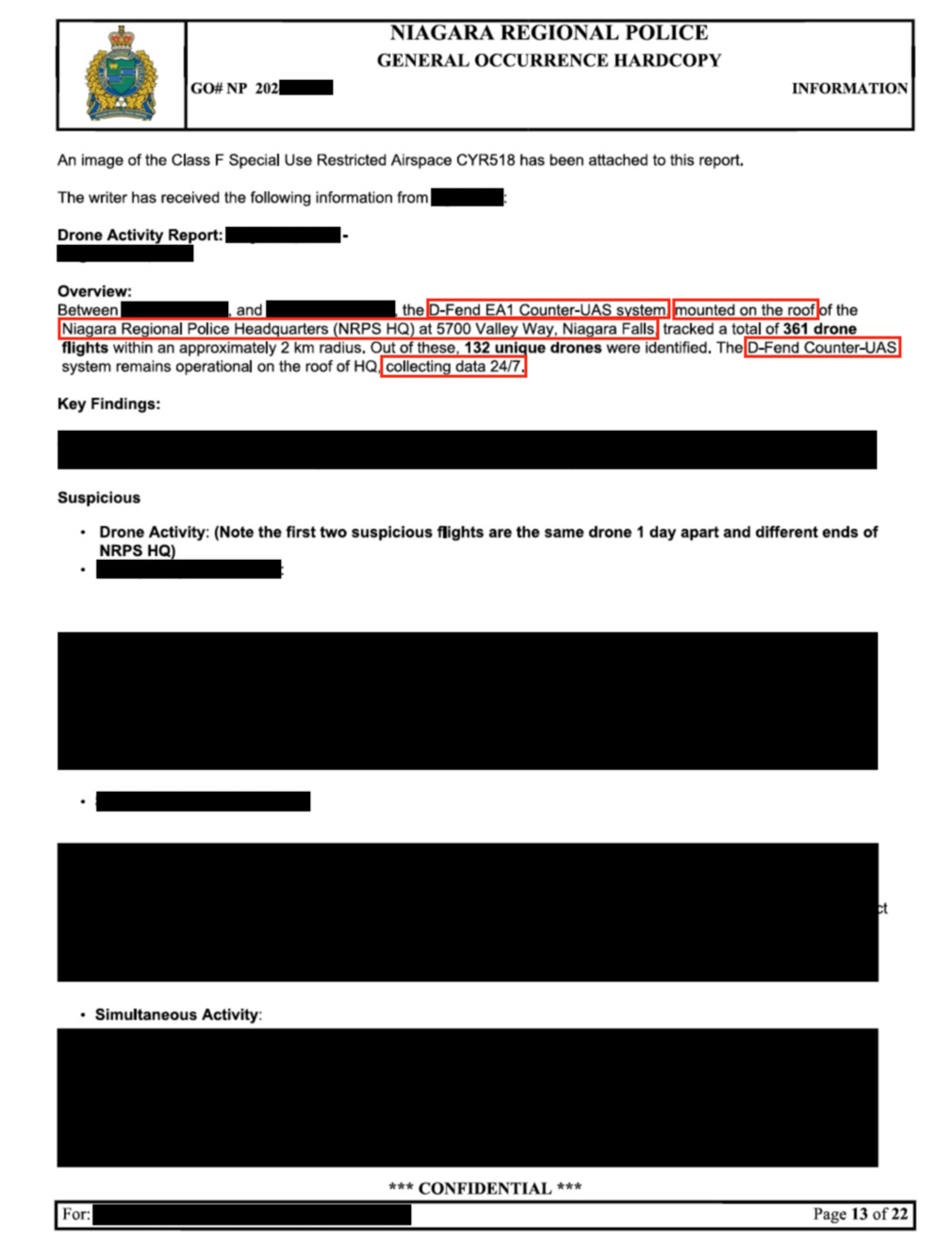
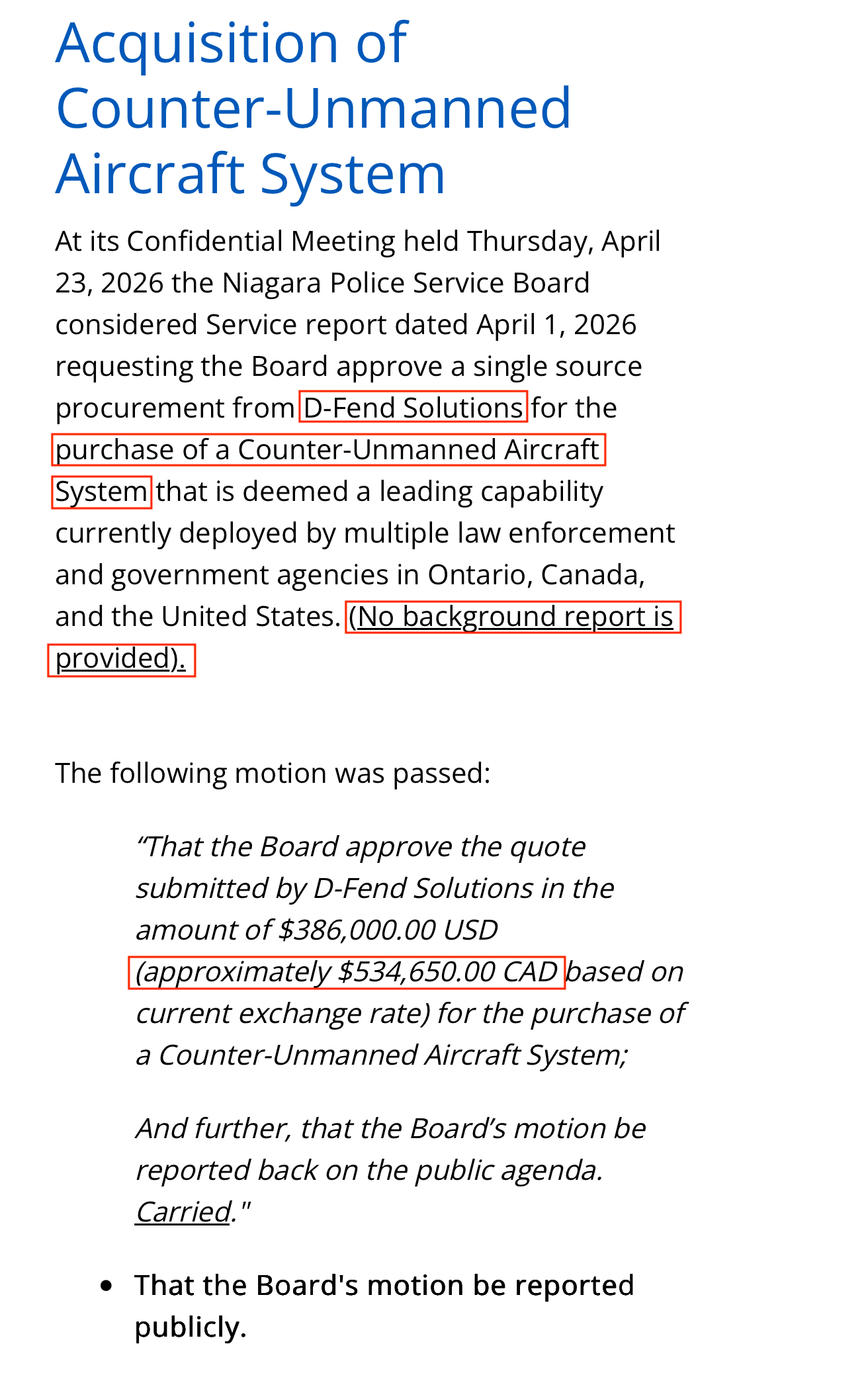
CONFIDENTIAL REPORTS SHOW THAT THE NRPS HAVE BEEN USING THIS COUNTER-DRONE TECHNOLOGY FOR YEARS WITHOUT OVERSIGHT OR REPORTING THIS TO THE NRPSB.
D-Fend’s flagship platform, EnforceAir, is designed to detect, identify, track, and assume control of unauthorized drones. Rather than functioning as a drone itself, the technology is intended to neutralize drones operated by others. This distinction is important because it fundamentally changes the nature of the discussion. Investments in search-and-rescue drones, emergency response capabilities, or aerial observation platforms are relatively easy for the public to understand. Counter-drone technology serves an entirely different purpose. It is designed to address a perceived threat.
The involvement of D-Fend introduces additional questions that were never publicly debated. The company is an Israeli-based defence technology firm whose products are used by military, security, and law-enforcement agencies around the world, including Israeli security forces (the IDF). Whether residents support or oppose the use of such technology is ultimately secondary to the larger issue: the decision was made without meaningful public discussion of the vendor, the alternatives, or the broader ethical considerations that often accompany defence-sector procurement.
The issue becomes even more significant when viewed in the context of the threat that this technology was intended to address.
In reporting on the purchase, Benner noted that Niagara Regional Police justified the expansion of its air-support capabilities by citing increasing threats to public safety, technological advances, evolving regulatory requirements, and the growing complexity of remotely piloted aircraft systems. Yet little public evidence has been presented to demonstrate that Niagara faces a drone-related threat commensurate with a half-million-dollar investment in counter-drone technology.
The available evidence points in the opposite direction.
Across Canada, drone usage has increased substantially over the past decade. At the same time, Transport Canada has repeatedly reported that the overwhelming majority of drone operators comply with existing regulations. Serious incidents remain rare.
Some of the most notable drone-related aviation incidents in Canadian history are remembered precisely because they are exceptional. In 2021, a York Regional Police drone collided with a civilian aircraft near Toronto’s Buttonville Airport. In 2020, an RCMP-operated drone struck an RCMP helicopter during a protest operation in British Columbia. These incidents received national attention because such occurrences are uncommon.
The local record is even more striking. There have been no publicly reported drone strikes in Niagara Region, no documented injuries, and no evidence of an escalating drone-safety crisis requiring extraordinary intervention. The region has not experienced the type of incidents that would ordinarily be expected to justify the acquisition of specialized counter-UAS technology costing more than half a million dollars.
This does not necessarily mean that police lacked a legitimate reason for the purchase. Law-enforcement agencies are often privy to information that cannot be publicly disclosed. However, the burden of justification increases as expenditures become larger and secrecy becomes more extensive. Public institutions cannot reasonably expect citizens to support significant investments solely on the basis of trust, particularly when those investments are shielded from public examination.
The secrecy surrounding this procurement has also intensified scrutiny of the relationships that can develop between public institutions and private technology vendors. Over the past several years, concerns have periodically surfaced regarding the close connections between certain members of the Niagara Regional Police Service and companies operating within the drone and counter-drone industry.
Large public contracts are not simply expected to be fair; they must also appear to be fair. The absence of public disclosure regarding vendors, procurement processes, and decision-making criteria makes it difficult for residents to assess whether appropriate safeguards were in place to prevent real or perceived conflicts of interest.
This is precisely why transparency matters. Open procurement processes protect not only taxpayers, but also public officials and police personnel from allegations that decisions may have been influenced by personal, professional, or financial relationships. When information is withheld, speculation flourishes. When information is disclosed, confidence can be earned.
The issue becomes even more consequential when viewed through the broader lens of policing and public oversight.
In recent years, police services across Ontario have increasingly embraced advanced technologies, including drones, automated licence plate readers, facial recognition systems, and predictive analytical tools. These technologies are frequently introduced with assurances that they will improve efficiency, enhance public safety, and modernize policing. Yet each technological expansion also increases the importance of transparency. Public confidence depends not only on whether a technology works, but on whether citizens understand how and why it is being deployed.
The role of the Police Services Board is particularly important in this context. Civilian oversight exists to ensure that decisions involving significant public expenditures are subjected to independent scrutiny. The purpose of oversight is not simply to approve recommendations advanced by police leadership. It is to evaluate whether proposed expenditures are necessary, proportionate, and in the public interest.
Ultimately, this controversy is not about drones. It is about trust. Public institutions derive their legitimacy from public confidence, and public confidence depends upon transparency. Citizens do not expect governments or police services to reveal every operational detail. They do, however, expect a clear explanation when more than half a million dollars of public money is spent on specialized surveillance and security technology.
Niagara residents paid for this system. They are entitled to understand what was purchased, why it was necessary, and how the decision was made. Until that information is provided, the central issue will remain unresolved. The problem is not merely the technology that was acquired. It is the secrecy that surrounded its acquisition.

WHEN A PRIDE FLAG BECOMES A TARGET: The Crown V Chandler C. Robinson
A recent incident involving the vandalism of a Pride flag at a public elementary school in Thorold, led to charges against Chandler Robinson for mischief. While the act seems straightforward, it raises questions about underlying motives tied to anti-2SLGBTQQIA+ sentiments. This incident highlights how targeted actions can symbolize deeper societal issues and provoke essential discussions…


ALONE AGAINST THE SYSTEM: Fighting Police Misconduct in Ontario Means Surviving It
In Ontario, holding police accountable isn’t a matter of justice — it’s an act of endurance.

THEY DEMANDED MY DEADNAME: Why I’m Taking the Niagara Regional Police Service to the Human Rights Tribunal
While filming a documentary in public, I was detained and pressured by Niagara Police to disclose my deadname—a name that no longer belongs to me. It was degrading, unlawful, and discriminatory. I’m fighting back through the Human Rights Tribunal to demand justice and dignity for all trans people.
WHEN THE COPS FEAR YOUR CAMERA: What It’s Like to Be a Trans Journalist in Ontario
Since November 2024, several constables and a few sergeants from the Ontario Provincial Police have dedicated hundreds of hours and significant resources to investigating and harassing me.
How Authoritarian Policies Fail the Unhoused in St. Catharines
The City of St. Catharines faces escalating homelessness under Mayor Mat Siscoe and administrator David Oakes, who promote punitive measures instead of meaningful solutions. Their actions reflect a disregard for the unhoused, showcasing a deeper societal failure to address the root causes of homelessness.

The Case for Transparency with Body-Worn Cameras
For more than five years, I have passionately championed the need for Body-Worn Cameras (BWCs) within the Niagara Regional Police Service (NRPS). This initiative became a cornerstone of my campaign when I ran for office in 2022.
- MAT SISCOE AND THE POLITICS OF THE GM SITE: How St. Catharines Keeps Setting the Table for BayShore
- POLICING THE CRITIC: A Story About NRPS Priorities
- WHEN A PRIDE FLAG BECOMES A TARGET: The Crown V Chandler C. Robinson
- SECRECY, SURVEILLANCE, AND THE PUBLIC’S RIGHT TO KNOW: Inside the NRPS’s Secret $534,000 Technology Purchase
- On the Failure of Escape

